
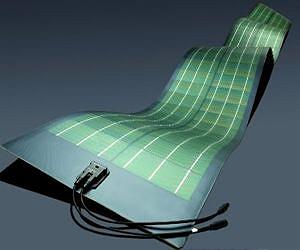
Global Solar Energy has announced that the Global Solar PowerFLEX BIPV roofing module has received the International Electrotechnical Commission (IEC) 61730 and 61646 certifications, as well as the Underwriters Laboratories (UL) 1703 certification.
The PowerFLEX BIPV is a flexible building integrated photovoltaic (BIPV) module, designed to quickly and cost-effectively deliver more power per rooftop than any other solar solution. These IEC and UL certifications demonstrate that the PowerFLEX BIPV module meets stringent safety, reliability and durability requirements set forth by both independent product testing organizations.
"Gaining UL and IEC certifications are essential achievements for the PowerFLEX BIPV module as we begin installations throughout the U.S. and Europe," said Dr. Jeff Britt, CEO of Global Solar Energy.
"With these certifications commercial building owners have gained a new option for creating clean, renewable energy that has been validated by these internationally renowned organizations."
Notably, the certifications validate that the Global Solar PowerFLEX BIPV modules can effectively provide safe electrical and mechanical operation during their expected lifetime, are suitable for long-term operation in general open-air climate and can be freestanding (not attached to buildings), in accordance with the National Electrical Code, National Fire Protection Agency (NFPA) 70 and Model Building Codes.
"In addition to providing a simple to install solution that quickly provides a return on investment, our high-powered, lightweight, flexible solar modules allow facility and building owners to fully optimize the real estate on the rooftop without compromising its functionality," continued Britt.
With 12.6 percent aperture efficiency, the PowerFLEX BIPV delivers the highest efficiency among flexible modules. PowerFLEX BIPV is also lightweight and can be applied directly to a roofing surface, requiring no mounting hardware, no roof penetrations, and creates no additional wind load maintaining the integrity and aesthetics of a building structure.
The module has a large format (5.75 m x 0.5 m) and a high power density (300 W), enabling it to outperform other flexible solar roofing solutions, including 50 percent more energy and power than the current amorphous silicon standard.
