|
 |
 |
 |
 |
 |
 |
 |
 |

 |
Kopin Selected For Award Of NASA Solar Cell Development Contract
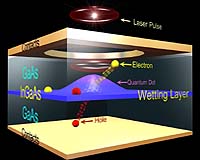
Taunton MA (SPX) May 02, 2008 Kopin has announced that it has been selected for the award of a $600,000 solar cell development contract from NASA. The contract is the second phase of a Small Business Technology Transfer (STTR) program to develop indium nitride (InN)-based quantum dot solar cell technology. Kopin"s partners on this NASA STTR project include groups at Virginia Tech and Magnolia Optical Technologies. "The goal of this STTR program is to develop high-efficiency solar cells that are resistant to extreme conditions while achieving high solar electric power conversion efficiency," said Dr. Roger Welser, Kopin"s Director of Technology and New Product Development. "The advanced patent-pending solar cell structure incorporating InN-based nanostructures can harness a very large fraction of the solar spectrum while minimizing the effects of high temperatures and high-energy radiation. This technology will enable photovoltaic power systems of future NASA space exploration missions to operate in extreme environments with high temperature and radiation exposures." Quantum-dot nanostructures allow the spectral response and operating voltage of a solar cell to be tailored in ways that are not possible with bulk semiconductor materials. In particular, the wide range of energies accessible to InN-based materials provides unique flexibility in designing quantum-dot solar cell structures. Phase I work demonstrated device-quality InN-based quantum dots exhibiting strong room-temperature photoluminescence, with peak emission energies ranging from the infrared to the ultraviolet. During the Phase II program, the InN-based quantum dots will be embedded within a higher band-gap GaN barrier material to demonstrate high efficiency and immunity to extreme environments. "The innovative structure, together with Kopin"s strength in manufacturing large quantities of epitaxial materials, renders Kopin an excellent choice for the NASA award," said Dr. John C.C. Fan, Kopin President and Chief Executive Officer. "This STTR project is part of Kopin"s long-term goal to address the emerging terrestrial renewable energy market by realizing the ultimate objective of high conversion efficiency at low costs. Kopin is currently exploring a number of options for synthesizing high-performance photovoltaic materials. Ultimately our approaches can provide pathways for realizing solar cells with power conversion efficiency approaching 60%, well beyond the current state-of-the-art efficiency of 40%." Related Links Kopin All About Solar Energy at SolarDaily.com
 ICP Solar Expands Distribution Relationship With Wal-Mart
 Montreal, Canada (SPX) May 02, 2008
ICP Solar Technologies has announced that Wal-Mart Stores will now carry the complete line of Coleman solar chargers including the CL100, CL300,CL600 CL1200 and the CC4000 charge controller on Walmart.com. |
|
|

| The content herein, unless otherwise known to be public domain, are Copyright Space.TV Corporation. AFP and UPI Wire Stories are copyright Agence France-Presse and United Press International. ESA Portal Reports are copyright European Space Agency. All NASA sourced material is public domain. Additional copyrights may apply in whole or part to other bona fide parties. Advertising does not imply endorsement, agreement or approval of any opinions, statements or information provided by Space.TV Corp on any Web page published or hosted by Space.TV Corp. Privacy Statement |