
 File image. |
The bendable devices are composed of water-based gel infused with light-sensitive molecules - the researchers used plant chlorophyll in one of the experiments - coupled with electrodes coated by carbon materials, such as carbon nanotubes or graphite.
The light-sensitive molecules get "excited" by the sun's rays to produce electricity, similar to plant molecules that get excited to synthesize sugars in order to grow, says NC State's Dr. Orlin Velev, Invista Professor of Chemical and Biomolecular Engineering and the lead author of a paper published online in the Journal of Materials Chemistry describing this new generation of solar cells.
Velev says that the research team hopes to "learn how to mimic the materials by which nature harnesses solar energy." Although synthetic light-sensitive molecules can be used, Velev says naturally derived products - like chlorophyll - are also easily integrated in these devices because of their water-gel matrix.
Now that they've proven the concept, Velev says the researchers will work to fine-tune the water-based photovoltaic devices, making them even more like real leaves.
"The next step is to mimic the self-regenerating mechanisms found in plants," Velev says. "The other challenge is to change the water-based gel and light-sensitive molecules to improve the efficiency of the solar cells."
Velev even imagines a future where roofs could be covered with soft sheets of similar electricity-generating artificial-leaf solar cells.
"We do not want to overpromise at this stage, as the devices are still of relatively low efficiency and there is a long way to go before this can become a practical technology," Velev says. "However, we believe that the concept of biologically inspired 'soft' devices for generating electricity may in the future provide an alternative for the present-day solid-state technologies."
Researchers from the Air Force Research Laboratory and Chung-Ang University in Korea co-authored the study. The study was funded by the Air Force Research Laboratory and the U.S. Department of Energy. The work is part of NC State's universitywide nanotechnology program, Nano@NC State.
NC State's Department of Chemical and Biomolecular Engineering is part of the university's College of Engineering.
 del.icio.us del.icio.us |
 Digg Digg |
 Reddit Reddit |
 YahooMyWeb YahooMyWeb |
 Google Google |
 Facebook Facebook |

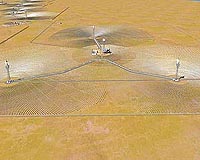 California Energy Commission Licenses Ivanpah Solar Electric Generating System
| The content herein, unless otherwise known to be public domain, are Copyright 1995-2010 - SpaceDaily. AFP and UPI Wire Stories are copyright Agence France-Presse and United Press International. ESA Portal Reports are copyright European Space Agency. All NASA sourced material is public domain. Additional copyrights may apply in whole or part to other bona fide parties. Advertising does not imply endorsement,agreement or approval of any opinions, statements or information provided by SpaceDaily on any Web page published or hosted by SpaceDaily. Privacy Statement |


