|
 |
 |
 |
 |
 |
 |
 |
 |

 |
An Impossible Alloy Now Possible
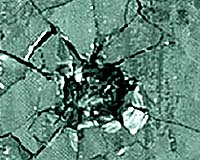
Uppsala, Sweden (SPX) Feb 27, 2009 What has been impossible has now been shown to be possible - an alloy between two incompatible elements. The findings are being published in the next edition of Proceedings of the National Academy of Science, USA. A research team led by Professor H.K. Mao from Carnegie Institution of Washington and Professor Rajeev Ahuja from UU have used high pressure experiments and theoretical calculations to study the behaviour of Ce3Al under high pressure. "We were surprised to find that Cerium and Aluminium formed a so called substitutional alloy under high pressure. Forming these alloys has been limited to elements close in atomic radii and electronegativity up until now", sais Professor Rajeev Ahuja of Uppsala University. The difference in radii and electronegativity of Cerium and Aluminium was diminished by applying pressure. Both synchrotron X-ray diffraction and ab initio calculations showed the same cause for bringing the two elements closer in radii and electronegativity, resulting in the new alloy phase. After the release of pressure the substitutional alloy still remained. "This discovery opens up the possibility for finding new alloys with other ratios between Cerium and Aluminium, as well as alloys with Cerium and other incompatible elements. These new alloys may possess interesting and useful mechanical, electronic, and magnetic properties". The new findings have been made possible by the recent development of high pressure diamond anvil cell and synchrotron radiation techniques. The extensive simulations were performed at Uppsala University's Multidisciplinary Center for Advanced Computational Science (UPPMAX). Related Links Uppsala University Space Technology News - Applications and Research
 Team Develops New Metamaterial Device
 Chestnut Hill MA (SPX) Feb 25, 2009
An engineered metamaterial proved it can function as a state-of-the-art device in the complex terahertz range of the electromagnetic spectrum, setting a standard of performance for modulating tiny waves of radiation, according to a team of researchers from Boston College, the Los Alamos and Sandia national laboratories, and Boston University. |
|
|

| The content herein, unless otherwise known to be public domain, are Copyright Space.TV Corporation. AFP and UPI Wire Stories are copyright Agence France-Presse and United Press International. ESA Portal Reports are copyright European Space Agency. All NASA sourced material is public domain. Additional copyrights may apply in whole or part to other bona fide parties. Advertising does not imply endorsement, agreement or approval of any opinions, statements or information provided by Space.TV Corp on any Web page published or hosted by Space.TV Corp. Privacy Statement |