|
 |
 |
 |
 |
 |
 |
 |
 |

 |
Astronomers Monitor Asteroid To Pass Near Mars
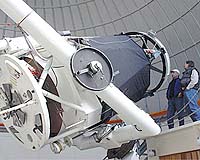
Pasadena CA (SPX) Dec 24, 2007 Astronomers funded by NASA are monitoring the trajectory of an asteroid estimated to be 50 meters (164 feet) wide that is expected to cross Mars' orbital path early next year. Observations provided by the astronomers and analyzed by NASA's Near-Earth Object Office at the Jet Propulsion Laboratory in Pasadena, Calif., indicate the object may pass within 30,000 miles of Mars at about 6 a.m. EST (3 a.m. PST) on Jan. 30, 2008. "Right now asteroid 2007 WD5 is about half-way between Earth and Mars and closing the distance at a speed of about 27,900 miles per hour," said Don Yeomans, manager of the Near Earth Object Office at JPL. "Over the next five weeks, we hope to gather more information from observatories so we can further refine the asteroid's trajectory." NASA detects and tracks asteroids and comets passing close to Earth. The Near Earth Object Observation Program, commonly called "Spaceguard," plots the orbits of these objects to determine if any could be potentially hazardous to our planet. Asteroid 2007 WD5 was first discovered on Nov. 20, 2007, by the NASA-funded Catalina Sky Survey and put on a "watch list" because its orbit passes near Earth. Further observations from both the NASA-funded Spacewatch at Kitt Peak, Ariz., and the Magdalena Ridge Observatory in New Mexico gave scientists enough data to determine that the asteroid was not a danger to Earth, but could potentially impact Mars. This makes it a member of an interesting class of small objects that are both near Earth objects and "Mars crossers." Because of current uncertainties about the asteroid's exact orbit, there is a 1-in-75 chance of 2007 WD5 impacting Mars. If this unlikely event were to occur, it would be somewhere within a broad swath across the planet north of where the Opportunity rover is located. "We estimate such impacts occur on Mars every thousand years or so," said Steve Chesley, a scientist at JPL. "If 2007 WD5 were to thump Mars on Jan. 30, we calculate it would hit at about 30,000 miles per hour and might create a crater more than half-a-mile wide." The Mars Rover Opportunity is exploring a crater approximately this size right now. Such a collision could release about three megatons of energy. Scientists believe an event of comparable magnitude occurred here on Earth in 1908 in Tunguska, Siberia, but no crater was created. The object was disintegrated by Earth's thicker atmosphere before it hit the ground, although the air blast devastated a large area of unpopulated forest. Related Links 2007 WD5 Podcast NEO at JPL Mars News and Information at MarsDaily.com Lunar Dreams and more
 International Group Plans Strategy For Mars Sample Return Mission
 Paris, France (ESA) Dec 21, 2007
ESA, NASA and an international team are developing plans and seeking recommendations to launch the first Mars mission to bring soil samples back to Earth. The ability to study soil from Mars here on Earth will contribute significantly to answering questions about the possibility of life on the Red Planet. |
|
|

| The content herein, unless otherwise known to be public domain, are Copyright Space.TV Corporation. AFP and UPI Wire Stories are copyright Agence France-Presse and United Press International. ESA Portal Reports are copyright European Space Agency. All NASA sourced material is public domain. Additional copyrights may apply in whole or part to other bona fide parties. Advertising does not imply endorsement, agreement or approval of any opinions, statements or information provided by Space.TV Corp on any Web page published or hosted by Space.TV Corp. Privacy Statement |