
 |
 |
 |
 |
 |
 |
 |
 |
 |

 |
Atom-smashing lab says experiment to start end-June
Geneva (AFP) May 27, 2008 European particle physics laboratory CERN is set to launch its gigantic experiment which hopes to throw light on the origins of the universe within a month, the laboratory's head said Tuesday. If things go according to plan, the greatest experiment in the history of particle physics could unveil a sub-atomic component, the Higgs Boson, known as "the God Particle." The "Higgs," named after the eminent British physicist, Peter Higgs, who first proposed it in 1964, would fill a gaping hole in the benchmark theory for understanding the physical cosmos. Other work on the so-called Large Hadron Collider (LHC) could explain dark matter and dark energy -- strange phenomena that, stunned astrophysicists discovered a few years ago, account for 96 percent of the universe. The LHC device "will be in working order by the end of June," CERN director general Robert Aymar told journalists. A gamble costing six billion Swiss francs (almost six billion dollars, 3.9 billion euros) that has harnessed the labours of more than 2,000 physicists from nearly three dozen countries, the LHC is the biggest, most powerful high-energy particle accelerator ever built. Beams of hydrogen protons will whizz around at near-light speed in opposite directions until, bent by powerful superconducting magnets, they will smash together in four bus-sized detector chambers, where they will be annihilated at temperatures hotter than the sun. But Aymar played down hopes of any immediate discoveries once the LHC is set in motion. "We will accumulate data for two years and it will take a lot of time to interpret," he said. He also scoffed at fears that the massive experiment could create a black hole with potentially devastating consequences for life on Earth. "The system is totally safe. There is nothing to fear," he said. Related Links Understanding Time and Space
 Swiss supercollider puts U.S. on sidelines
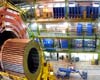 Dallas (UPI) May 25, 2008
 As the Swiss prepare to unveil a powerful particle accelerator, the United States finds itself in the "minor leagues" of particle physics, scientists say. |
|
|

| The content herein, unless otherwise known to be public domain, are Copyright Space.TV Corporation. AFP and UPI Wire Stories are copyright Agence France-Presse and United Press International. ESA Portal Reports are copyright European Space Agency. All NASA sourced material is public domain. Additional copyrights may apply in whole or part to other bona fide parties. Advertising does not imply endorsement, agreement or approval of any opinions, statements or information provided by Space.TV Corp on any Web page published or hosted by Space.TV Corp. Privacy Statement |

