|
|
|
|
|
|
|
|
|
|
|


| . |  |
. |
|
|
|
 by Emil Venere for Purdue News West Lafayette IN (SPX) Sep 14, 2012
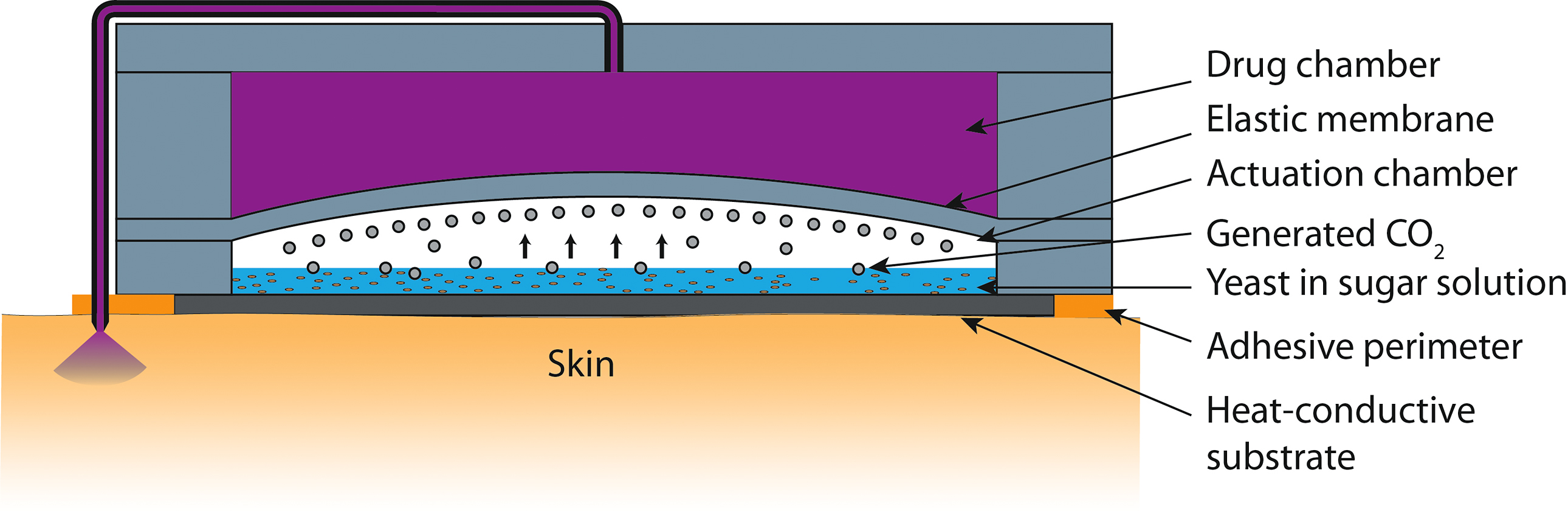
Researchers have created a new type of miniature pump activated by body heat that could be used in drug-delivery patches powered by fermentation. The micropump contains Baker's yeast and sugar in a small chamber. When water is added and the patch is placed on the skin, the body heat and the added water causes the yeast and sugar to ferment, generating a small amount of carbon dioxide gas. The gas pushes against a membrane and has been shown to continually pump for several hours, said Babak Ziaie, a Purdue University professor of electrical and computer engineering and biomedical engineering. Such miniature pumps could make possible drug-delivery patches that use arrays of "microneedles" to deliver a wider range of medications than now possible with conventional patches. Unlike many other micropumps under development or in commercial use, the new technology requires no batteries, said Ziaie, who is working with doctoral student Manuel Ochoa. "This just needs yeast, sugar, water and your own body heat," Ziaie said. The robustness of yeast allows for long shelf life, and the design is ideal for mass production, Ochoa said. "It would be easy to fabricate because it's just a few layers of polymers sandwiched together and bonded," he said. Findings were detailed in a research paper published online in August in the journal Lab on a Chip. The paper was written by Ochoa and Ziaie, and the research is based at Purdue's Birck Nanotechnology Center in the university's Discovery Park. The "the microorganism-powered thermopneumatic pump" is made out of layers of a rubberlike polymer, called polydimethylsiloxane, which is used commercially for diaphragms in pumps. The prototype is 1.5 centimeters long. Current "transdermal" patches are limited to delivering drugs that, like nicotine, are made of small hydrophobic molecules that can be absorbed through the skin, Ziaie said. "Many drugs, including those for treating cancer and autoimmune disorders cannot be delivered with patches because they are large molecules that won't go through the skin," he said. "Although transdermal drug delivery via microneedle arrays has long been identified as a viable and promising method for delivering large hydrophilic molecules across the skin, a suitable pump has been hard to develop." Patches that used arrays of tiny microneedles could deliver a multitude of drugs, and the needles do not cause pain because they barely penetrate the skin, Ziaie said. The patches require a pump to push the drugs through the narrow needles, which have a diameter of about 20 microns, or roughly one-fourth as wide as a human hair. Most pumps proposed for drug-delivery applications rely on an on-board power source, which is bulky, costly and requires complex power-management circuits to conserve battery life. "Our approach is much more simple," Ziaie said. "It could be a disposable transdermal pump. You just inject water into the patch and place it on your skin. After it's used up, you would throw it away." Researchers have filed an application for a provisional patent on the device.
Related Links Purdue University Hospital and Medical News at InternDaily.com
|
|
|
| The content herein, unless otherwise known to be public domain, are Copyright 1995-2014 - Space Media Network. AFP, UPI and IANS news wire stories are copyright Agence France-Presse, United Press International and Indo-Asia News Service. ESA Portal Reports are copyright European Space Agency. All NASA sourced material is public domain. Additional copyrights may apply in whole or part to other bona fide parties. Advertising does not imply endorsement,agreement or approval of any opinions, statements or information provided by Space Media Network on any Web page published or hosted by Space Media Network. Privacy Statement |

 del.icio.us
 Digg
Digg Reddit
 Google