
 |
 |
 |
 |
 |
 |
 |
 |
 |

 |
Boeing Submits Proposals For Ares V Rocket Design Support
Huntsville AL (SPX) Feb 19, 2009 Boeing has announced that its Space Exploration division has submitted proposals to NASA for the Ares V Phase 1 Design Support Contracts. Boeing submitted proposals for design support of the Ares V cargo launch vehicle's payload shroud, which will protect the Altair lunar lander during launch; the Earth-departure stage; the core stage, a liquid-fueled central booster element; and avionics and software. The work includes assessing requirements, risks and opportunities; performing trade studies and analysis; and producing final reports. The company proposes to use the experience of its Huntsville-based team, supplemented by expertise from across Boeing, to develop products that will enable NASA to verify the Ares V design concept and demonstrate that the launch vehicle can meet its mission objectives. "Boeing has designed and produced shrouds for Delta, Sea Launch and Titan rockets, and we've defined avionics and subsystem architectures across a wide range of aerospace products, including Delta, the space shuttle, the International Space Station and Ares I," said Jim Chilton, Boeing vice president of Exploration Launch Systems. "We're pleased to have the chance to bring this experience to NASA and Ares V." The two-stage, vertically stacked Ares V will serve as NASA's primary rocket for safe, reliable delivery of large-scale hardware to space - from the lunar landing craft and materials for establishing a moon base to food, water and other staples needed to extend a human presence beyond Earth's orbit. The Ares V Phase 1 contracts will be managed out of NASA's Marshall Space Flight Center in Huntsville. Related Links Boeing Integrated Defense Systems Rocket Science News at Space-Travel.Com
 Japan Unveils New Rocket
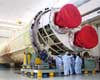 Nagoya, Japan (AFP) Feb 17, 2009
Nestled in a cavernous but air-tight hangar, scientists are putting the finishing touches to Japan's H-2B rocket, hoping it will boost the country's prestige when it blasts off later this year. |
|
|

| The content herein, unless otherwise known to be public domain, are Copyright Space.TV Corporation. AFP and UPI Wire Stories are copyright Agence France-Presse and United Press International. ESA Portal Reports are copyright European Space Agency. All NASA sourced material is public domain. Additional copyrights may apply in whole or part to other bona fide parties. Advertising does not imply endorsement, agreement or approval of any opinions, statements or information provided by Space.TV Corp on any Web page published or hosted by Space.TV Corp. Privacy Statement |

