 |
 |
 |
 |
 |
 |
 |
 |
 |

 |
Canada's Arctic ice shelves break apart, drift away
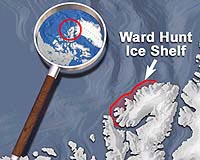
Ottawa (AFP) Sept 3, 2008 Two ice shelves in Canada's far north have lost massive sections since August while a third ice shelf now is adrift in the Arctic Ocean, said researchers Wednesday who blamed climate change. The entire 50 square-kilometer (19 square-mile) Markham Ice Shelf off the coast of Ellesmere Island broke away in early August and is now adrift, while two sections of the nearby Serson Ice Shelf detached, reducing its mass by 60 percent or 122 square kilometers (47 square miles). Ward Hunt Ice Shelf, which halved in July, lost an additional 22 square kilometers (8.5 square miles). "These changes are irreversible under the present climate and indicate that the environmental conditions that have kept these ice shelves in balance for 4,000 years are no longer present," said Trent University's polar expert Derek Mueller. Canada's summer ice shelf losses now total 214 square kilometers (82.5 square miles), which is more than three times the area of Manhattan Island, the researchers said. Extensive cracks in Ward Hunt, the largest remaining ice shelf, means it will continue to disintegrate in the coming years, said Luke Copland, director Ottawa University's cryospheric research lab. In an interview with AFP, Copland blamed "very warm temperatures" and "reduced sea ice" for the crumbling ice shelves. The sea ice usually braced the shelves and without it, wind and waves more easily broke them apart, he explained. The coast of Ellesmere Island has also warmed an average of two degrees (Celsius) in the last 50 years, he said. In winter, temperatures are now five degrees warmer, making it more difficult for ice lost in summer to recover in winter. "We see that warming is concentrated in the winter," Copland said. "It's part of global warming. When we warm up the planet it gets concentrated close to he poles." "Usually the ice shelves would use the winter to recover from the previous summer. They would reform, ... but the ice shelf can't recover in the winter anymore." "We have now reached a threshold where (the environment) is too warm for these ice shelves to exist anymore," he said. "What it tells us is that the Arctic is changing." Mueller told AFP: "It underscores the rapidity of the changes, how quickly things are moving along in the Arctic." "Its not just the ice shelves that are changing. These changes are occurring in concert with sea ice reduction and other indications of climate change," he said. The Ellesmere ice shelves were formed some 4,500 years ago, composed of sea ice, accumulated snow and glacier ice up to 40 meters (131 feet) thick. The detached pieces broke into numerous 'ice islands' (tabular icebergs) whose fate could take many forms, said researchers. Martin Jeffries of the US National Science Foundation and University of Alaska Fairbanks, and who has studied the Ellesmere ice shelves since 1982, said they could float along the northern edge of Queen Elizabeth Islands toward the Beaufort Sea or enter the Canadian Archipelago. The Canadian Ice Service is tracking the broken pieces. Related Links Beyond the Ice Age
 Climate change threatens massive glacier disappearance
 Geneva (AFP) Sept 1, 2008
The United Nations said Monday that swathes of mountain ranges worldwide risk losing their glaciers by the end of the century if global warming continues at its projected rate. |
|
|

| The content herein, unless otherwise known to be public domain, are Copyright Space.TV Corporation. AFP and UPI Wire Stories are copyright Agence France-Presse and United Press International. ESA Portal Reports are copyright European Space Agency. All NASA sourced material is public domain. Additional copyrights may apply in whole or part to other bona fide parties. Advertising does not imply endorsement, agreement or approval of any opinions, statements or information provided by Space.TV Corp on any Web page published or hosted by Space.TV Corp. Privacy Statement |