|
 |
 |
 |
 |
 |
 |
 |
 |

 |
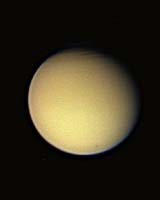
Cassini Conducts Titan Flyby Number 28
Paris, France (ESA) Mar 27, 2007 Just 16 days after Titan-26, Cassini returns to Titan for its twenty-eighth targeted encounter. The closest approach to Titan occurs on Monday, 26 March 2007 at 00:23 UT at an altitude of 1010 kilometres above the surface and at a speed of 6.2 kilometres per second. The latitude at closest approach is 41.1 N and the encounter occurs on orbit number 41. Around closest approach, Cassini passes behind Titan for approximately 35 minutes as seen from Earth. This flyby configuration allows for radio observations to be made of Titan's atmosphere, with a radio signal passing through the atmosphere which is subsequently received on Earth. In addition bistatic radio measurements will be made of the moon's surface, by sending a radio signal at grazing angles, which after bouncing of Titan's surface is received on Earth and provides information on the surface properties. This encounter is set up with two manoeuvres: an apoapsis manoeuvre on 17 March, and an approach manoeuvre, scheduled for 22 March. This is the third in a series of outbound Titan encounters (until T34, 19 July 2007) and occurs about 3 days after Saturn closest approach.
Science Activities
+ Radio Science Subsystem (RSS) A T27 ingress/egress occultation of Titan's atmosphere will provide a high-spatial-resolution electron number density profile of the ionosphere, temperature-pressure and absorption profiles of the neutral atmosphere, as well as information about the small-scale structure of the atmosphere. The ingress latitude is -71.3 and the egress latitude is 54. The previous two RSS Titan occultations had ingress latitudes of -29 and -30.9. The previous egress latitudes were -49 and -32.5. T31 (28 May 2007) will be the fourth and final RSS Titan occultation and it will have an ingress latitude of -75.4 and an egress latitude of 74.6. In addition, inbound and outbound RSS bistatic scattering observations of Titan's surface will provide information about the dielectric constant, nature, and roughness of the region probed. This RSS bistatic observation is in the deep southern hemisphere, over one of the very large dark regions shown in the imaging data. In the north, these large dark regions have turned out to be most likely hydrocarbon seas and lakes.
+ Ultraviolet Imaging Spectrograph (UVIS) UVIS will perform several slow scans across Titan's visible hemisphere to form spectral images.
+ Imaging Science Subsystem (ISS) Extending coverage north of Belet and Adiri.
+ Composite Infrared Spectrometer (CIRS) Inbound CIRS is doing a far-IR composition integration and a mid-IR limb composition integration. Outbound CIRS is doing a far-IR limb composition integration, far-IR surface temperature scan, and a mid-IR composition integration. Related Links Cassini-Huygens Jupiter and its Moons Explore The Ring World of Saturn and her moons Jupiter and its Moons The million outer planets of a star called Sol News Flash at Mercury
 Enceladus Geysers Mask the Length Of Saturn's Day
 Pasadena CA (SPX) Mar 23, 2007
In a David and Goliath story of Saturnian proportions, the little moon Enceladus is weighing down giant Saturn's magnetic field so much that the field is rotating slower than the planet. This phenomenon makes it nearly impossible to measure the length of the Saturn day using techniques that work at the other giant planets. |
|
|

| The content herein, unless otherwise known to be public domain, are Copyright Space.TV Corporation. AFP and UPI Wire Stories are copyright Agence France-Presse and United Press International. ESA Portal Reports are copyright European Space Agency. All NASA sourced material is public domain. Additional copyrights may apply in whole or part to other bona fide parties. Advertising does not imply endorsement, agreement or approval of any opinions, statements or information provided by Space.TV Corp on any Web page published or hosted by Space.TV Corp. Privacy Statement |