|
 |
 |
 |
 |
 |
 |
 |
 |

 |
Chemists work on bamboo fabric development
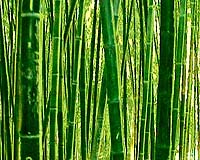
Fort Collins, Colo., April 8, 2008 U.S. chemists said they've solved two problems that have slowed marketplace adoption of bamboo garments and other consumer products. Colorado State University graduate student Subhash Appidi and Associate Professor Ajoy Sarkar have discovered now to make bamboo fabric that's resistant to the sun's ultraviolet radiation and also has anti-bacterial properties. "Bamboo is environmentally friendly," said Appidi. "Pesticides and other agents are necessary to grow most other natural fibers -- (but) there is nothing like that in bamboo production." Despite bamboo's promise as an environmentally friendly fiber, Appidi said raw bamboo fabric allows UV radiation to reach the skin. And Appidi found untreated bamboo fabric did not live up to antimicrobial expectations. "All cellulose fibers allow more moisture to leak in and provide more food for bacteria to eat," he said. "That's why bacteria grow more on natural fibers rather than synthetic fibers." The researchers increased the UV-protecting abilities of the fabric by coloring bamboo cloth in a dye laced with UV absorbing chemicals. To improve bamboo's antibacterial properties Appidi treated fabric with Tinosan -- an antibacterial agent. The details of the research were reported Monday in New Orleans during the spring national meeting of the American Chemical Society. Related Links Space Technology News - Applications and Research
 Researchers Explore Materials Degradation In Space
 Arlington VA (AFNS) Mar 31, 2008
When Space Shuttle Endeavor launched March 11, more than 1,000 new materials were onboard to be tested as a part of the sixth Materials International Space Station Experiment, or MISSE-6. The Air Force Office of Scientific Research initiated MISSE-6 to gain a theoretical understanding of the mechanisms involved in materials degradation. |
|
|

| The content herein, unless otherwise known to be public domain, are Copyright Space.TV Corporation. AFP and UPI Wire Stories are copyright Agence France-Presse and United Press International. ESA Portal Reports are copyright European Space Agency. All NASA sourced material is public domain. Additional copyrights may apply in whole or part to other bona fide parties. Advertising does not imply endorsement, agreement or approval of any opinions, statements or information provided by Space.TV Corp on any Web page published or hosted by Space.TV Corp. Privacy Statement |