|
 |
 |
 |
 |
 |
 |
 |
 |

 |
China Launches Second Oceanic Survey Satellite
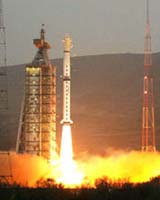
Taiyuan, China (XNA) Apr 13, 2007 China successfully launched its second oceanic survey satellite "Haiyang-1B" (Ocean 1B) from Taiyuan Satellite Launching Center on Wednesday. The China-made satellite was launched at 11:27 a.m. and reached the target orbit aboard a Long March-2C carrier rocket, China's most senior ocean research official said. The "Haiyang-1B", a crucial component of China's three dimensional oceanic survey system, would be used to monitor the color and temperature of the ocean, said Sun Zhihui, director of the State Oceanic Administration. The satellite would aid China's development and utilization of oceanic resources, construction of ports, monitoring and prevention of oceanic pollution, resource investigation and the development of coastal areas as well as for study of global environmental changes, he said. China launched its first oceanic survey satellite "Haiyang-1A" in May 2002 to monitor ocean color and temperature using remote sensing technology "Haiyang-1A" monitored the Bohai Sea, the Yellow Sea, the East China Sea and the South China Sea. Chief scientist Bai Zhaoguang said the "Haiyang-1B" is an upgraded version of the earlier model. "The operational life of 'Haiyang-1B' is expected to reach three years, a year longer than 'Haiyang-1A'. The new satellite provides three times as much information," he said. "The satellite's observational devices now have a 3,000-kilometer range -- up from 1,300 kilometers -- and its imaging devices provide higher resolution photography," he added. Haiyang-1B had a stronger structure than Haiyang-1A, enabling it to withstand stronger shocks and jolts, he said. Bai said the Haiyang-1B had software and Internet capabilities that allowed it to repair itself in space, saying 10 computers worked together to repair the spacecraft in the event of a technical breakdown. The breakdown of a solar cell driver shortened Haiyang-1A's operational life. But Haiyang-1B's improved technology would enable it to solve this kind of problem by itself, Bai said. The "Haiyang-1A", China's first experimental satellite to use ocean color detecting, worked for 685 days from May 2002 to April 2004 with an operational life shorter than the designed lifespan of two years. During its operation, it completed 1,830 surveys and provided oceanic information for 126 users including the oceanic administration, producers of oceanic products, research institutes and universities. SOA director Sun Zhihui said China would develop five more oceanic satellites in the medium term, saying satellites were urgently needed to develop the country's marine economy, provide a marine early warning system and safeguard the nation's maritime rights. "Haiyang-1B" is developed by the China Academy of Space Technology of China Aerospace Science and Technology Corp (CASTC).It was launched on the 96th flight of a Long March carrier rocket, which was developed by the China Academy of Launch Vehicle Technology of the CASTC. Source: Xinhua News Agency Related Links China State Oceanic Administration Water, Water Everywhere and Not A Drop To Drink... Water News - Science, Technology and Politics
 Tasmania Supports NASA's Ocean Satellite Missions
 Hobart, Australia (SPX) Mar 23, 2007
At the conclusion of the first international ocean satellite meeting in Hobart last week, scientists reviewed objectives and opportunities for the joint NASA/French Space Agency satellite to be launched in June next year. The meeting was sponsored locally by the CSIRO Wealth from Oceans Research Flagship, the Bureau of Meteorology and the Royal Australian Navy. |
|
|

| The content herein, unless otherwise known to be public domain, are Copyright Space.TV Corporation. AFP and UPI Wire Stories are copyright Agence France-Presse and United Press International. ESA Portal Reports are copyright European Space Agency. All NASA sourced material is public domain. Additional copyrights may apply in whole or part to other bona fide parties. Advertising does not imply endorsement, agreement or approval of any opinions, statements or information provided by Space.TV Corp on any Web page published or hosted by Space.TV Corp. Privacy Statement |