 |
 |
 |
 |
 |
 |
 |
 |
 |

 |
Defense Focus: Carrier strategy -- Part 5
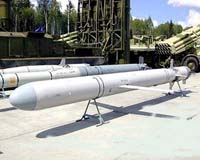
Washington, April 1, 2008 Russian and Chinese naval weapons designers know they lack the resources and the technology to match the awesome power of U.S. aircraft carrier battle groups ship for ship and plane for plane. So instead, for decades, they have opted for asymmetrical solutions to the problem of killing U.S. super carriers. And they have come up with some lethal weapons. Russian military systems designers look to be able to produce large numbers of weapons based on relatively simple designs that are cost-effective and robust on the battlefield. And when confronted with U.S. weapons systems that they cannot match directly like stealth bombers or nuclear-powered super aircraft carriers, they look for asymmetrical solutions that enable them to use their own areas of expertise. Therefore, although Russia has still to demonstrate it can successfully build and operate a modern, 21st century-era large aircraft carrier, it leads the world in designing and producing relatively cheap missile systems designed to "kill" such carriers at scores, and even hundreds of miles distance. The U.S. arsenal has no weapons to compare with the Russian-built Moskit 3M80 -- NATO designation SS-N-22 Sunburn -- ramjet-powered cruise missile or the new, even more advanced SS-N-27 Sizzler. These weapons fly two and a half times faster than U.S. ones. American cruise missiles are subsonic, but Russian-made ones can fly at well over Mach 2, or more than twice the speed of sound -- with speeds estimated at 1,500 mph to 1,700 mph at close to ground level. Russia has sold the technology to build the Moskit to China, which manufactures it as the Hai Ying or Sea Eagle HY2. It can carry an almost 500-pound warhead, and it can deliver a tactical nuclear weapon. The threat of the Hai Ying is so great that it has effectively barred operational access to the Taiwan Strait to U.S. aircraft carriers in time of high tension. China has also supplied the Hai Ying to Iran. It is striking that four-star Adm. William Fox Fallon, who has just resigned as head of U.S. Central Command, has expressed his caution and reluctance about going to war with Iran. Fallon is the U.S. Navy's leading expert, and therefore probably the top authority in the world, about using aircraft carrier-based air power to strike land-based targets. His previous position was running Pacific Command with great distinction, and that theater includes China and Taiwan. Fallon's caution is clearly based in part on the fact that U.S. carrier battle groups would have to be operated with great discretion and skill to protect them from the threat of Iran's Sunburns. The threat that the Moskit SS-N-22 Sunburn -- and now its younger more advanced sister, the SS-N-27 Sizzler -- pose to U.S. aircraft carriers is very similar to the one that German battleships' 15-inch, or 381mm, plunging shell-fire fired from long range posed to British battlecruisers in World War II. The Bismarck, as previously noted in this series, sank the legendary and enormous, but only lightly armored, HMS Hood with a single long-range shell that detonated its powder magazine. Respected analyst David Crane, writing in Defense Review in November 2006, concluded bleakly, "Bottom line, our aircraft carriers are vulnerable against the latest Russian and Chinese torpedo and missile tech, and with the current U.S. naval defense philosophy, that situation isn't likely to change anytime soon." It is difficult to disagree with this prognosis. Related Links Naval Warfare in the 21st Century
 Carrier Conflicts Part Two
 Moscow (UPI) Mar 28, 2008
 With no full information available on details of the refitting of the Russian aircraft carrier Admiral Gorshkov for service in the Indian navy as the Indian carrier Vikramaditya, it might be of interest to take a look at the ship itself and the plans for retrofitting. |
|
|

| The content herein, unless otherwise known to be public domain, are Copyright Space.TV Corporation. AFP and UPI Wire Stories are copyright Agence France-Presse and United Press International. ESA Portal Reports are copyright European Space Agency. All NASA sourced material is public domain. Additional copyrights may apply in whole or part to other bona fide parties. Advertising does not imply endorsement, agreement or approval of any opinions, statements or information provided by Space.TV Corp on any Web page published or hosted by Space.TV Corp. Privacy Statement |