
Solar Energy News
SOLAR DAILY
Engineered ligands deliver durable high efficiency perovskite solar cells
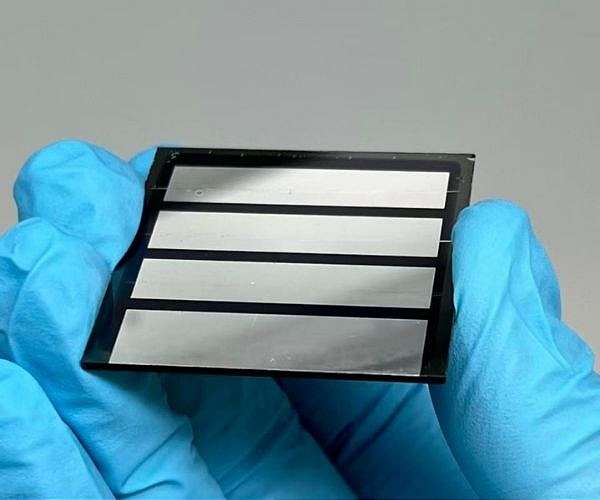
illustration only

Engineered ligands deliver durable high efficiency perovskite solar cells

by Sophie Jenkins
London, UK (SPX) Jan 14, 2026

Scientists have reported a new way to make perovskite solar cells both highly efficient and markedly more stable, directly tackling one of the main obstacles to bringing this emerging photovoltaic technology into large scale deployment.

Perovskite semiconductors have been widely promoted as candidates for the next generation of solar power because they can be processed at low temperatures into thin, lightweight and potentially flexible devices that could be cheaper to manufacture than conventional silicon panels. However, leading perovskite formulations tend to degrade under sustained heat or illumination, causing rapid efficiency losses and limiting their practical operating lifetimes in real world conditions.

A team led by Professor Thomas Anthopoulos from The University of Manchester has now demonstrated that carefully engineered surface chemistry can substantially reinforce device stability without sacrificing power output. The researchers focused on the ultra thin molecular layers that form at the interface between the traditional three dimensional perovskite absorber and its surrounding environment, a region that plays a critical role in both charge transport and environmental protection.

In the new work, the group used specially designed small molecules known as amidinium ligands, which act like a molecular glue to help hold the perovskite lattice together at the surface. By tuning the chemical structure of these multivalent ligands, they were able to direct the growth of a low dimensional perovskite phase on top of the bulk three dimensional material, creating a highly ordered interfacial architecture.

These low dimensional surface layers form a smooth, continuous and robust protective coating that suppresses the formation of tiny defects and traps, which otherwise act as initiation points for decomposition and non radiative recombination. The improved structural order and defect passivation allow electrical charges generated by sunlight to move more freely through the device while shielding the underlying perovskite from damaging thermal and photochemical stresses.

Using this dimensional engineering strategy, the team fabricated inverted perovskite solar cells that reached a power conversion efficiency of 25.4 percent, placing them among the most efficient devices reported for this architecture. Crucially, the cells maintained more than 95 percent of their initial performance after 1,100 hours of continuous operation at 85 degrees Celsius under full sunlight, a demanding test condition that simulates prolonged field exposure.

Professor Anthopoulos said that this stability advance could help resolve one of the final major challenges for perovskite photovoltaics as they move towards commercialisation. He noted that although state of the art perovskite devices already rival silicon in power output, their long term reliability has lagged behind because many material compositions are intrinsically unstable when exposed to heat or high intensity light for extended periods.

According to Anthopoulos, the amidinium ligands developed in this project, together with the fundamental understanding gained about how they regulate interfacial structure, now provide a route to grow high quality and resilient perovskite layers in a controlled and reproducible manner. He suggested that integrating such tailored surface chemistries into scalable manufacturing processes could help ensure that perovskite modules last long enough to compete directly with established photovoltaic technologies in rooftop, building integrated and utility scale applications.

The full research report, published in the journal Science, details how the multivalent nature of the ligands enables precise control over the dimensional engineering of the perovskite interface and links these structural changes to measured gains in efficiency and stability. The authors also discuss how the concepts demonstrated here could be adapted to other perovskite compositions and device architectures, potentially broadening the impact of this approach across the rapidly evolving field of perovskite optoelectronics.

Research Report:Multivalent ligands regulate dimensional engineering for inverted perovskite solar modules

Related Links
The University of Manchester
All About Solar Energy at SolarDaily.com

Subscribe Free To Our Daily Newsletters
Tweet

RELATED CONTENT
The following news reports may link to other Space Media Network websites.
SOLAR DAILY
Osmium dye boosts long wavelength solar hydrogen output
Tokyo, Japan (SPX) Jan 09, 2026
Generating hydrogen from sunlight offers a route to low carbon fuel production by converting solar energy into chemical energy stored in hydrogen. Researchers use photocatalysts to absorb light and drive water splitting into hydrogen and oxygen, but many existing systems only harvest part of the visible spectrum, leaving much of the incoming solar energy unused. To increase solar-to-hydrogen efficiency, researchers are investigating photocatalysts that respond to a broader range of visible wavelengths. ... read more

SOLAR DAILY
Biochar layer boosts hydrogen rich gas yields from corn straw

Carbon monoxide enables rapid atomic scale control for fuel cell catalysts

Singapore sets course for 'green' methanol ship fuel supplies

Methane conversion enabled by iron catalyst delivers pharmaceutical compounds

SOLAR DAILY
Brew, smell, and serve: AI steals the show at CES 2026

Miniature quadruped robot achieves record performance and resilience

EU orders Musk's Grok AI to keep data after nudes outcry

Nvidia CEO praises robots as 'AI immigrants'

SOLAR DAILY
Trump gets wrong country, wrong bird in windmill rant

S.Africa seeks to save birds from wind turbine risks

Vertical wind turbines may soon power UK railways using tunnel airflow

SOLAR DAILY
GM announces $7.1 bn hit to profits on electric auto pullback

Electric vehicles could catch on in Africa sooner than expected

EU offers China alternative to tariffs in electric cars dispute

Trimble positioning tech to enhance Lucid Gravity lane level navigation

SOLAR DAILY
Volvo Cars pauses battery factory after fruitless partner search

Perovskite betavoltaic cell sets record efficiency using carbon 14 source

Lithium ion battery study on Tiangong space station explores microgravity effects on performance

China ramps up CHSN01 fusion magnet jacket for cryogenic reactors

SOLAR DAILY
Meta partners with US nuclear companies to power AI data centers

Bayesian neural net sharpens thorium 232 fission yield data

Microbes join forces to quickly clean up uranium pollution

Japan nuclear official loses phone with confidential data in China

SOLAR DAILY
Chinese villagers struggle for heat as gas subsidies fade

Understanding ammonia energy's tradeoffs around the world

Cold winter and AI boom pushed US emissions increase in 2025

France climate goals off track as emissions cuts slow again

SOLAR DAILY
Clearing small areas of rainforest has outsized climate impact: study

Climate-driven tree deaths speeding up in Australia

Indonesia to revoke 22 forestry permits after deadly floods

How deforestation turbocharged Indonesia's deadly floods

Subscribe Free To Our Daily Newsletters


The content herein, unless otherwise known to be public domain, are Copyright 1995-2024 - Space Media Network. All websites are published in Australia and are solely subject to Australian law and governed by Fair Use principals for news reporting and research purposes. AFP, UPI and IANS news wire stories are copyright Agence France-Presse, United Press International and Indo-Asia News Service. ESA news reports are copyright European Space Agency. All NASA sourced material is public domain. Additional copyrights may apply in whole or part to other bona fide parties. All articles labeled "by Staff Writers" include reports supplied to Space Media Network by industry news wires, PR agencies, corporate press officers and the like. Such articles are individually curated and edited by Space Media Network staff on the basis of the report's information value to our industry and professional readership. Advertising does not imply endorsement, agreement or approval of any opinions, statements or information provided by Space Media Network on any Web page published or hosted by Space Media Network. General Data Protection Regulation (GDPR) Statement Our advertisers use various cookies and the like to deliver the best ad banner available at one time. All network advertising suppliers have GDPR policies (Legitimate Interest) that conform with EU regulations for data collection. By using our websites you consent to cookie based advertising. If you do not agree with this then you must stop using the websites from May 25, 2018. Privacy Statement. Additional information can be found here at About Us.