|
 |
 |
 |
 |
 |
 |
 |
 |

 |
Exercise Reverses Aging In Human Skeletal Muscle
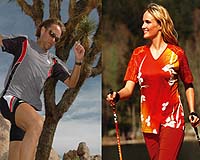
Ontario, Canada (SPX) May 23, 2007 Buck Institute faculty leads study showing 'genetic fingerprint' becoming younger in healthy seniors who did resistance training Not only does exercise make most people feel better and perform physical tasks better, it now appears that exercise - specifically, resistance training -- actually rejuvenates muscle tissue in healthy senior citizens. A recent study, co-led by Buck Institute faculty member Simon Melov, PhD, and Mark Tarnopolsky, MD, PhD, of McMaster University Medical Center in Hamilton, Ontario, involved before and after analysis of gene expression profiles in tissue samples taken from 25 healthy older men and women who underwent six months of twice weekly resistance training, compared to a similar analysis of tissue samples taken from younger healthy men and women. The results of the study appear in the May 23 edition of the on-line, open access journal PLoS One. The gene expression profiles involved age-specific mitochondrial function; mitochondria act as the "powerhouse" of cells. Multiple studies have suggested that mitochondrial dysfunction is involved in the loss of muscle mass and functional impairment commonly seen in older people. The study was the first to examine the gene expression profile, or the molecular "fingerprint", of aging in healthy disease-free humans. Results showed that in the older adults, there was a decline in mitochondrial function with age. However, exercise resulted in a remarkable reversal of the genetic fingerprint back to levels similar to those seen in the younger adults. The study also measured muscle strength. Before exercise training, the older adults were 59% weaker than the younger adults, but after the training the strength of the older adults improved by about 50%, such that they were only 38% weaker than the young adults. "We were very surprised by the results of the study," said Melov. "We expected to see gene expressions that stayed fairly steady in the older adults. The fact that their 'genetic fingerprints' so dramatically reversed course gives credence to the value of exercise, not only as a means of improving health, but of reversing the aging process itself, which is an additional incentive to exercise as you get older." The study participants were recruited at McMaster University. The younger (20 to 35 with an average age of 26) and older (older than 65 with an average age of 70) adults were matched in terms of diet and exercise; none of them took medication or had diseases that can alter mitochondrial function. Tissue samples were taken from the thigh muscle. The six month resistance training was done on standard gym equipment. The twice-weekly sessions ran an hour in length and involved 30 contractions of each muscle group involved, similar to training sessions available at most fitness centers. The strength test was based on knee flexion. The older participants, while generally active, had never participated in formal weight training said co-first author Tarnopolsky, who directs the Neuromuscular and Neurometabolic Clinic at McMaster University. In a four month follow up after the study was complete, he said most of the older adults were no longer doing formal exercise in a gym, but most were doing resistance exercises at home, lifting soup cans or using elastic bands. "They were still as strong, they still had the same muscle mass," said Tarnopolsky. "This shows that it's never too late to start exercising and that you don't have to spend your life pumping iron in a gym to reap benefits." Future studies are being designed to determine if resistance training has any genetic impact on other types of human tissue, such as those that comprise organs; researchers also want to determine whether endurance training (running, cycling) impacts mitochondrial function and the aging process. The most recent study also points to particular gene expressions that could be used as starting points for chemical screenings that could lead to drug therapies that would modulate the aging process. "The vast majority of aging studies are done in worms, fruit flies and mice; this study was done in humans," said Melov. "It's particularly rewarding to be able to scientifically validate something practical that people can do now to improve their health and the quality of their lives, as well as knowing that they are doing something which is actually reversing aspects of the aging process." Related Links Buck Institute for Age Research All About Human Beings and How We Got To Be Here
 Sweden Mulls Freeze-Drying As New Burial Method
 Stockholm (AFP) May 16, 2007
Sweden is considering allowing freeze-drying as a new method to bury the dead instead of traditional burials and cremations, Culture Minister Lena Adelsohn Liljeroth told the Swedish church's weekly paper on Wednesday. "I would like to push for the issue of freeze-drying. I think it is interesting and based on what I have heard I have a positive view of the method," Adelsohn Liljeroth, whose brief covers burial laws, told Kyrkans Tidning. |
|
|

| The content herein, unless otherwise known to be public domain, are Copyright Space.TV Corporation. AFP and UPI Wire Stories are copyright Agence France-Presse and United Press International. ESA Portal Reports are copyright European Space Agency. All NASA sourced material is public domain. Additional copyrights may apply in whole or part to other bona fide parties. Advertising does not imply endorsement, agreement or approval of any opinions, statements or information provided by Space.TV Corp on any Web page published or hosted by Space.TV Corp. Privacy Statement |