
 |
 |
 |
 |
 |
 |
 |
 |
 |

 |

Warwick, UK (SPX) May 25, 2011 Researchers at the University of Warwick have found a unique feuding double white dwarf star system where each star appears to have been stripped down to just its helium. We know of just over 50 close double white dwarfs but this was only the second ever eclipsing close white dwarf pair to be found. The University of Warwick astronomers Steven Parsons and Professor Tom Marsh were able to use the fact that the stars eclipse each other when seen from Earth to make particularly detailed observations of the system. These observations revealed that uniquely both the white dwarf stars in this pairing are composed largely of helium. Most white dwarfs tend to have largely inert cores of carbon and oxygen that have formed over the star's long life when it has used up most of its hydrogen and helium. Helium white dwarfs are a sure sign that the star has undergone some extreme mass loss at some point. To find two such helium white dwarfs stars is a clear sign to astronomers that both stars have had an exotic and mutually destructive past. What was originally the most massive star of the pair had once actually began to expand to become a red giant but its outer hydrogen envelope was ripped off by its companion. This meant the star never got an opportunity to start fusing its helium and it was left as a helium white dwarf. When the companion star then began expanded it also had its expanding layer torn off by the first star - but as the first star was already reduced to a white dwarf it could not use that new material. That hydrogen was therefore simply lost to the star system leaving behind helium white dwarfs. In just over 1 billion years, the two stars feud will end as they will spiral together and merge, finally igniting each other's helium to become an object known as a hot subdwarf which should last for 100 million years The University of Warwick researchers found this star system CSS 41177 (which is over 351 parsecs , or 1140 light years, away - in the constellation Leo) using a combination of data from the robotic 2m Liverpool Telescope in the Canary Islands and the 8m Gemini Telescope on Hawaii.
Share This Article With Planet Earth
Related Links University of Warwick Stellar Chemistry, The Universe And All Within It

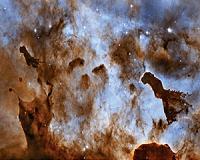 Nearby Supernova Factory Ramps Up
Boston MA (SPX) May 25, 2011 A local supernova factory has recently started production, according to a wealth of new data from NASA's Chandra X-ray Observatory on the Carina Nebula. This discovery may help astronomers better understand how some of the Galaxy's heaviest and youngest stars race through their lives and release newly-forged elements into their surroundings. Located in the Sagittarius-Carina arm of the Mil ... read more |
|
|
| The content herein, unless otherwise known to be public domain, are Copyright 1995-2010 - SpaceDaily. AFP and UPI Wire Stories are copyright Agence France-Presse and United Press International. ESA Portal Reports are copyright European Space Agency. All NASA sourced material is public domain. Additional copyrights may apply in whole or part to other bona fide parties. Advertising does not imply endorsement,agreement or approval of any opinions, statements or information provided by SpaceDaily on any Web page published or hosted by SpaceDaily. Privacy Statement |


 del.icio.us
 Digg
Digg Reddit
 YahooMyWeb
 Google
 Facebook







