|
 |
 |
 |
 |
 |
 |
 |
 |

 |
Global Carbon Budgeting Requires Proper Accounting Of Inland Waters
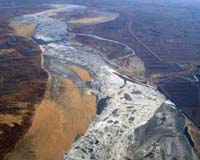
Santa Barbara CA (SPX) Apr 05, 2007 Life as we know it, from the most basic microbes to our human neighbors, is carbon based. By investigating how carbon cycles through ecosystems, scientists can learn valuable information about food chains, nutrient cycling, and productivity. Because carbon dioxide is a greenhouse gas, with the ability to influence temperature, an accurate global carbon budget is needed to address climate change. On Earth, carbon is continually cycling through terrestrial systems, inland waters, the ocean, and the atmosphere. Until little over a decade ago, when calculating the terrestrial component of the global carbon budget, inputs were limited to the ocean and the land. Because inland water bodies cover less than 1 per cent of the Earth's surface, it was assumed that their contribution was inconsequential. This view was recently challenged in an Ecosystems paper highlighting the findings of a National Center for Ecological Assessment and Synthesis analysis. Carried out by a team of international scientists, including Institute of Ecosystem Studies Biogeochemist Dr. Jonathan J. Cole, the paper's senior author, the group reveals that inland water bodies are important areas of terrestrial carbon transformation that deserve inclusion in global carbon cycle assessments. While rivers were introduced into global carbon budget assessments in the late 90s, Cole and colleagues argue that current models are limited by a narrow definition of how rivers transport carbon. By depicting rivers as "pipes" that passively deliver terrestrial carbon to the sea, models fail to capture the complex transformations that occur on the journey toward the ocean. The fact is, according to the authors, that half of the terrestrial carbon entering inland waters is destined for a fate outside of the ocean's salty shores. Where does the remaining terrestrial carbon go? Approximately 40% is returned to the atmosphere as CO2 and 12% is stored in sediments. This holds true across a range of inland systems, from lakes and rivers to reservoirs and wetlands. Carbon budgets that are based on the passive pipe view are flawed because in-system transformations fall off the balance sheets. Even if models were adjusted to embrace a more dynamic view of river inputs, they would need further amending to include the true range of inland waters. Take, for instance, the role played by lakes and reservoirs. By burying carbon in their sediments, lakes serve as important regional carbon stores. In aggregate, lakes play a significant role in the global carbon budget. On an annual basis, they bury 40% as much carbon as the ocean. Reservoirs, which are steadily increasing in number, bury more organic carbon than all natural lake basins combined and exceed oceanic organic carbon burial by more than 1.5-fold. These findings debunk the concept that inland waters are inconsequential when accounting for the global carbon budget; instead they are places of complex and active carbon transformation. The take home message from the authors: "Continental hydrologic networks, from river mouths to the smallest upstream tributaries, do not act as neutral pipes- they are active players in the carbon cycle despite their modest size." As global carbon budget models move from static boxes to dynamic flows, future models should take into account the myriad of ways that inland waters contribute to the carbon cycle. In many cases, these aquatic systems are biogeochemical "hot spots" within the terrestrial landscape with contributions that are significant at regional to global scales. Related Links National Center for Ecological Assessment and Synthesis Institute of Ecosystem Studies Water, Water Everywhere and Not A Drop To Drink... Learn about Climate Science at TerraDaily.com Water News - Science, Technology and Politics
 10 Million Face China Water Shortage
 Beijing (AFP) March 26, 2007
Nearly 10 million people across southern and southwestern China are suffering from drinking water shortages due to a fierce drought, state media reported on Monday. A lack of rainfall has affected water supplies for 9.8 million people and 9.1 million head of livestock, the Beijing Morning Post said. |
|
|

| The content herein, unless otherwise known to be public domain, are Copyright Space.TV Corporation. AFP and UPI Wire Stories are copyright Agence France-Presse and United Press International. ESA Portal Reports are copyright European Space Agency. All NASA sourced material is public domain. Additional copyrights may apply in whole or part to other bona fide parties. Advertising does not imply endorsement, agreement or approval of any opinions, statements or information provided by Space.TV Corp on any Web page published or hosted by Space.TV Corp. Privacy Statement |