
Solar Energy News
SOLAR DAILY
Hydrogen bond design advances solar water oxidation efficiency
illustration only

Hydrogen bond design advances solar water oxidation efficiency

by Riko Seibo
Tokyo, Japan (SPX) Feb 16, 2026

Hydrogen bonds, best known for holding water and biomolecules together, now show a powerful role in solar energy conversion as part of a new supramolecular photocatalyst for water oxidation. Researchers from Inner Mongolia University and Tsinghua University report that carefully engineered hydrogen bond interactions can reshape charge behavior inside organic photocatalysts, opening a route to more efficient artificial photosynthesis.

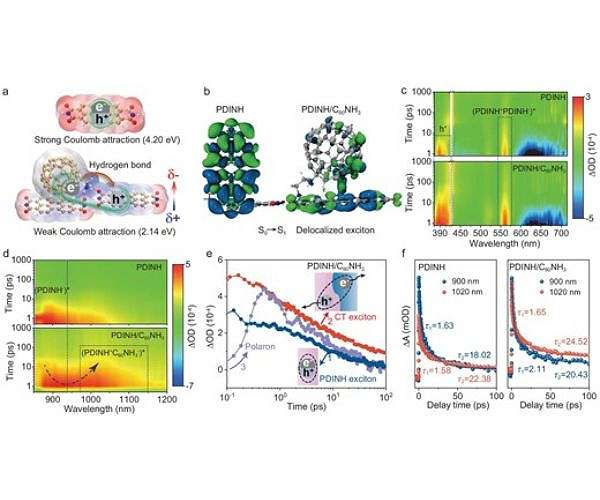
The team constructed a photocatalyst in which hydrogen bonds link an electron donor, a perylene diimide supramolecule, to an electron acceptor, an aminated fullerene unit. These hydrogen bonds create a strongly charge polarized local environment that enhances dielectric screening and weakens the Coulomb attraction between photogenerated electrons and holes. At the same time, the directional nature of the hydrogen bonds provides well defined pathways that support exciton delocalization across the donor acceptor interface.

By transforming tightly bound Frenkel type excitons into weakly bound charge transfer excitons, the hydrogen bonded structure lowers exciton binding energy and enables spontaneous exciton dissociation under visible light. This spontaneous separation means that a larger fraction of the absorbed photon energy appears as mobile charges that can drive redox chemistry rather than recombining as heat or light. The result is more effective utilization of photogenerated charges in the subsequent water oxidation reaction.

Compared with conventional supramolecular assemblies formed from single component molecular building blocks, the hydrogen bond engineered donor acceptor composite develops a much stronger internal electric field. This internal field arises from the strong electronic interactions at the interface and the asymmetric charge distribution imposed by the hydrogen bonds. The strengthened field steers electrons and holes in opposite directions, driving more rapid and directional charge migration through the photocatalyst particles.

Under operating conditions, the researchers observed that the hydrogen bonded system significantly increased the population of useful surface holes, which are the active oxidizing agents in water splitting. After charge extraction and recombination processes were accounted for, the effective surface hole concentration was enhanced by a factor of six relative to a comparable system lacking hydrogen bonded interfaces. With more oxidizing holes reaching the catalyst surface, the rate of the water oxidation half reaction rises sharply.

In performance tests under visible light irradiation, the hydrogen bonded photocatalyst achieved an oxygen evolution rate of 63.9 millimoles per gram per hour. The material also delivered apparent quantum efficiencies of 11.83 percent at 420 nanometers and 4.08 percent at 650 nanometers, indicating that it can use not only higher energy blue light but also lower energy red light to drive oxygen evolution. These figures place the system among the best reported organic photocatalysts for oxygen evolution under similar conditions.

Most previous work on hydrogen bond based photocatalysts has centered on promoting hydrogen evolution, hydrogen peroxide formation, or carbon dioxide reduction, where electron driven reduction processes dominate. By contrast, the oxygen evolution reaction is the more sluggish, kinetically demanding half step of overall water splitting, and progress in this area has been comparatively slow. The new study shows that hydrogen bond engineering can be applied directly to this challenging oxidative step.

By demonstrating a hole dominated organic semiconductor platform with state of the art oxygen evolution performance, the work offers a design blueprint for constructing efficient overall water splitting systems. It suggests that tailoring the local electrostatic potential, exciton landscape, and internal electric field through supramolecular hydrogen bonding can provide a versatile handle for tuning charge dynamics. Such strategies may be extended to other organic or hybrid photocatalysts aiming at solar fuel production and related photoelectrochemical transformations.

Research Report: Hydrogen bond promoted exciton dissociation for efficient photocatalytic water oxidation

Related Links
Department of Chemistry of Tsinghua University
All About Solar Energy at SolarDaily.com

Subscribe Free To Our Daily Newsletters
Tweet

RELATED CONTENT
The following news reports may link to other Space Media Network websites.
SOLAR DAILY
Study maps path to cleaner terawatt scale solar manufacturing
London, UK (SPX) Feb 13, 2026
Pioneering research led by Northumbria University shows how the global solar industry can expand manufacturing of photovoltaic technology while further shrinking its environmental footprint. As solar power deployment accelerates to meet climate targets and rising electricity demand, the work tackles the challenge of making sure this growth is both scalable and sustainable rather than simply shifting environmental burdens elsewhere in the energy system. Published in Nature Communications, the ... read more

SOLAR DAILY
Neem seed biochar turns waste into thermal energy storage medium

Salt solvent unlocks lignin for next generation biofuel plants

Pilot plant in Mannheim delivers tailored climate friendly fuel blends

Garden and farm waste targeted as feedstock for new bioplastics

SOLAR DAILY
All-in on AI: what TikTok creator ByteDance did next

Hot bots: AI agents create surprise dating accounts for humans

Miniature quadruped robot achieves record performance and resilience

Flexible electronics reshape intelligent robot design

SOLAR DAILY
China added record wind and solar power in 2025, data shows

UK nets record offshore wind supply in renewables push

Trump gets wrong country, wrong bird in windmill rant

SOLAR DAILY
China space firm tests two seat flying car concept in Chongqing

China top court says drivers responsible despite autonomous technology

Mercedes-Benz net profit nearly halves amid China, US woes

Carney scraps Canada EV sales mandate, affirms auto sector's future is electric

SOLAR DAILY
Deep learning model tracks EV battery health with high precision

UCSB scientists bottle the sun with liquid battery

Soil microbe turns carbon dioxide into acetate using electricity

MoSi2 material points to new route for turning waste heat into power

SOLAR DAILY
Microbes join forces to quickly clean up uranium pollution

France bets on nuclear power to phase out fossil fuels

Japan restarts world's biggest nuclear plant again

Japan to restart world's biggest nuclear plant

SOLAR DAILY
'Hard to survive': Kyiv's elderly shiver after Russian attacks on power and heat

Zelensky seeks more air defence as Russia plunges Kyiv into cold

US to repeal the basis for its climate rules: What to know

Understanding ammonia energy's tradeoffs around the world

SOLAR DAILY
Landsat study maps boreal forest shift north

Indigenous Brazilians protest Amazon river dredging for grain exports

Protected forests under threat in DRC's lucrative mining belt

Protected forests under threat in DRC's lucrative mining belt

Subscribe Free To Our Daily Newsletters


The content herein, unless otherwise known to be public domain, are Copyright 1995-2024 - Space Media Network. All websites are published in Australia and are solely subject to Australian law and governed by Fair Use principals for news reporting and research purposes. AFP, UPI and IANS news wire stories are copyright Agence France-Presse, United Press International and Indo-Asia News Service. ESA news reports are copyright European Space Agency. All NASA sourced material is public domain. Additional copyrights may apply in whole or part to other bona fide parties. All articles labeled "by Staff Writers" include reports supplied to Space Media Network by industry news wires, PR agencies, corporate press officers and the like. Such articles are individually curated and edited by Space Media Network staff on the basis of the report's information value to our industry and professional readership. Advertising does not imply endorsement, agreement or approval of any opinions, statements or information provided by Space Media Network on any Web page published or hosted by Space Media Network. General Data Protection Regulation (GDPR) Statement Our advertisers use various cookies and the like to deliver the best ad banner available at one time. All network advertising suppliers have GDPR policies (Legitimate Interest) that conform with EU regulations for data collection. By using our websites you consent to cookie based advertising. If you do not agree with this then you must stop using the websites from May 25, 2018. Privacy Statement. Additional information can be found here at About Us.