|
 |
 |
 |
 |
 |
 |
 |
 |

 |
Inauguration Of The Galileo Control Centre At DLR
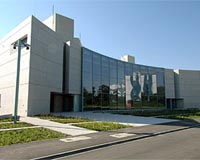
Oberpfaffenhofen, Germany (SPX) Sep 17, 2008 On 8 September 2008, the new building complex for the Galileo Control Centre at the German Aerospace Center (Deutsches Zentrum fur Luft- und Raumfahrt; DLR) in Oberpfaffenhofen was formally handed over. "For the staff of the new Galileo Control Centre, this marks the beginning of the actual preparation phase for the operation of the future European satellite navigation system Galileo", said Professor Johann-Dietrich Worner, Chairman of the DLR Executive Board. Worner went on to say: "By operating the Galileo Control Centre, DLR shows how important its Oberpfaffenhofen site is and how significant science can be as an economic factor when it joins forces with political and other partners." In a festive ceremony, the Berlin-based architectural firm "Schultes Frank Architekten" presented a symbolic key to DLR. The importance of the Galileo project for Europe, Germany and Bavaria was underlined by the attendance of EU Commissioner for Transport Antonio Tajani, Prime Minister Gunther Beckstein of the Free State of Bavaria, as well as Bavarian State Minister Emilia Muller and Matthias von Randow, State Secretary of the German Federal Ministry of Transport, Building and Urban Affairs (Bundesministerium fur Verkehr, Bau und Stadtentwicklung). The new control centre, with over 3000 square metres of floor space, was completed after just two years of building work. The fully-equipped building has cost about 100 million euro. By the time the Galileo satellite navigation system is fully operational, up to 100 engineers and scientists will be working at over 30 control consoles in the control centre in Oberpfaffenhofen. A multinational team is responsible for preparing and operating Galileo. Staff of the other European Galileo Control Centres will also be present in Oberpfaffenhofen so as to ensure close coordination and cooperation. The Galileo Control Centre in Oberpfaffenhofen is part of the core ground segment. The satellites are controlled and mission data is received through a globally distributed ground station network. The control centre in Oberpfaffenhofen is equipped with state-of-the-art infrastructure in order to meet the high demands made on the Galileo infrastructure and to ensure failure-free operation for the next 20 years. Important navigational data as well as the reference time which is relevant for all Galileo applications are generated on the ground in the control centres and transmitted to the Galileo satellites via the ground stations. Related Links German Aerospace Center GPS Applications, Technology and Suppliers
 SSTL Completes Galileo In-Orbit Test Campaign
 Guildford, UK (SPX) Sep 10, 2008
SSTL has completed an in-orbit test campaign analysing signals from the new GIOVE-B satellite for ESA. The results suggest that GIOVE-B is operating well and in turn validates technologies integral to the EU-funded Galileo Satellite Navigation project. |
|
|

| The content herein, unless otherwise known to be public domain, are Copyright Space.TV Corporation. AFP and UPI Wire Stories are copyright Agence France-Presse and United Press International. ESA Portal Reports are copyright European Space Agency. All NASA sourced material is public domain. Additional copyrights may apply in whole or part to other bona fide parties. Advertising does not imply endorsement, agreement or approval of any opinions, statements or information provided by Space.TV Corp on any Web page published or hosted by Space.TV Corp. Privacy Statement |