|
 |
 |
 |
 |
 |
 |
 |
 |

 |
Indonesia's forests: a precious resource in climate change fight
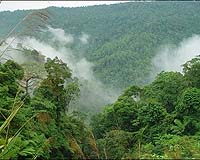
Pangkalan Kerinci, Indonesia (AFP) Nov 23, 2007 Indonesia's vast forests have long been seen by governments and businesses alike as a resource to be exploited for massive profit. But as worldwide climate negotiations approach in Bali next month, keeping the nation's forests just as they are could become a new multi-billion-dollar industry. A drive to do just that is called Reduced Emissions from Deforestation and Degradation (REDD), which in its simplest form proposes to transform the carbon saved by not cutting down trees into a tradeable commodity. The proposal is especially pressing in Indonesia, where the clearing and burning of peatlands -- ecosystems comprising swamps of semi-decomposed plantlife -- account for four percent of total global greenhouse gas emissions, according to Greenpeace. Swathes of peatland are being cleared to make way for pulp and paper plantations, and the booming palm oil industry. But Indonesia is slowly waking up to the hidden cost of releasing the huge stores of carbon kept in peatland, said Daniel Mudiyarso, an expert at Indonesia's Centre for International Forestry Research. "We used to hear the term 'marginal land' for this kind of ecosystem, but our awareness (of its importance) is increasing," Mudiyarso said. The December 3-14 UN summit will bring together delegates from around the world -- including more than 100 ministers -- to work on a framework for talks on a global regime to combat climate change after the current phase of the Kyoto Protocol ends in 2012. Under the protocol as it now stands, nations that replant destroyed forests or plant new trees can gain climate credits, which can be bought and sold on the global market. But there are still no significant financial incentives for countries such as Indonesia to not cut their forests in the first place, said Fitrian Ardiansyah, the head of WWF Indonesia's climate change campaign. Indonesia is spearheading the charge to get REDD recognised. It has helped put together the so-called F11 grouping, made up of developing nations with the largest remaining tropical forests. If REDD becomes a part of a global agreement after 2012 -- when the current phase of Kyoto expires -- it would mean avoided deforestation credits would be part of a global carbon market with a global carbon price, as opposed to the ad hoc voluntary schemes that now exist. The potential worldwide market for REDD credits could be 15 billion dollars a year, estimates Rizaldi Boer, an academic from Indonesia's Bogor Agricultural University. He estimated Indonesia's share at around two billion dollars. A recent meeting between the Indonesian government, non-government organisations and foreign donors in Jakarta at the start of November aimed to set the wheels in motion for Indonesia's REDD push at Bali. But not all signs are good that Indonesia's leaders are pursuing REDD with a single-minded focus. The nation's environment minister Rachmat Witoelar was a no-show at the conference. The forestry minister Malem Sambat Kaban did turn up to address the conference, but spent much of the week under attack for writing a letter of recommendation for businessman Adelin Lis, who was acquitted of illegal logging charges in early November, triggering an outcry from environmentalists, the media and politicians. "My principle is everything should be beneficial for Indonesia, everything should have advantages for Indonesia," Kaban told the conference. "Like it or not, we have to create initiatives to reduce greenhouse gas emissions and realise we have to do it with other nations." Kaban stressed however that the government was not out to freeze landclearing altogether, saying: "The REDD scheme will not be something counterproductive to plantations." Related Links Forestry News - Global and Local News, Science and Application
 Dalai Lama bemoans deforestation of Tibet
 Tokyo (AFP) Nov 21, 2007
The Dalai Lama called Wednesday for special care to preserve Tibet's ecosystem, saying that corruption among Chinese bureaucrats was worsening deforestation. |
|
|

| The content herein, unless otherwise known to be public domain, are Copyright Space.TV Corporation. AFP and UPI Wire Stories are copyright Agence France-Presse and United Press International. ESA Portal Reports are copyright European Space Agency. All NASA sourced material is public domain. Additional copyrights may apply in whole or part to other bona fide parties. Advertising does not imply endorsement, agreement or approval of any opinions, statements or information provided by Space.TV Corp on any Web page published or hosted by Space.TV Corp. Privacy Statement |