|
 |
 |
 |
 |
 |
 |
 |
 |

 |
Is Russian Armor Strong Enough
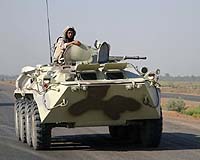
RIA Novosti political commentator Moscow (RIA Novosti) Oct 22, 2007 Under the current federal rearmament program, the Russian Armed Forces will replace 45% of their operational military equipment before 2015. Although strategic offensive arms are still the main element of national security, the specifications of lightweight armored vehicles must be upgraded. Thankfully, an all-out war seems out of the question. However, dozens of local conflicts, counter-terrorist and peacekeeping operations and convoy missions have been conducted since the beginning of the 21st century. It is obvious that strategic bombers or main battle tanks cannot effectively guard, defend and supply the numerous military bases maintained all over the world by industrialized countries and superpowers. Lightweight, high-speed and mobile, wheeled and tracked amphibious combat vehicles can quickly and effectively deploy military units, deliver essential supplies to conflict zones and reliably shield strategic installations. Wheeled vehicles are more preferable because they are less complicated, cheaper, faster and more maneuverable. In all, 40 tank, 90 motorized rifle and 50 airborne battalions will be reequipped by 2015. But experts are still unsure of the specifications for the new wheeled vehicles and armored personnel carriers (APCs). Combat vehicles designed many years ago and mass-produced today are not the best option, and new-generation models considerably superior to those developed 50 years ago are not in the pipeline. However, new motorized rifle units desperately need last generation lightweight armored vehicles. General Alexei Maslov, Commander of the Russian Army, said the correlation between service branches had changed, and that the Army now has more motorized rifle units than tank units. The U.S. Department of Defense and Gibbs Technologies are currently developing an amphibious all-terrain vehicle with a maximum speed of 130 kph on water and 105 kph on land. Unfortunately, operational Russian combat vehicles are still inferior to American ones. Russia and the Commonwealth of Independent States (CIS) have only two wheeled APCs, namely, the BTR-70 and BTR-80 which are, in fact, modified versions of the BTR-60, developed in the late 1950s. The four-axle BTR-60 had a combat weight of 10.3 tons and was fitted with two 90-h.p. GAZ-49B engines that gave it limited cross-country capability. Russian and foreign reference books note that the revamped BTR-70 and BTR-80 APCs have two gasolene and one diesel engine, respectively, instead of the two outdated gasoline engines. The BTR-70 currently features two 120-h.p. gasolene carburetor engines. In 1984, the Soviet Army first adopted the production BTR-80 amphibious APCs that had the same layout as their predecessors. Currently, each BTR-80 features a 210-h.p. diesel engine. Unlike the CIS, the U.S.-British coalition offers six modern APC models. In 1979, Cadillac Gage, renamed Textron Marine and Land Systems in 1994, developed the three-axle LAV-300 amphibious APC, now used in the coalition. The Russian military must improve the specifications of combat vehicles because future weapons systems will be mainly assessed in terms of their strategic and tactical mobility. The opinions expressed in this article are the author's and do not necessarily represent those of RIA Novosti.
Source: RIA Novosti Related Links
 Russian Air Force To Get Two Strategic Bombers Every Three Years
 Zarya, Russia (RIA Novosti) Jan 18, 2007
Two strategic bombers will be commissioned to the Russian Air Force every three years, the Air Force commander-in-chief said Thursday. Russia is currently carrying out an ambitious program to upgrade and modernize its strategic Air Force assets. |
|
|

| The content herein, unless otherwise known to be public domain, are Copyright Space.TV Corporation. AFP and UPI Wire Stories are copyright Agence France-Presse and United Press International. ESA Portal Reports are copyright European Space Agency. All NASA sourced material is public domain. Additional copyrights may apply in whole or part to other bona fide parties. Advertising does not imply endorsement, agreement or approval of any opinions, statements or information provided by Space.TV Corp on any Web page published or hosted by Space.TV Corp. Privacy Statement |