
 |
 |
 |
 |
 |
 |
 |
 |
 |

 |

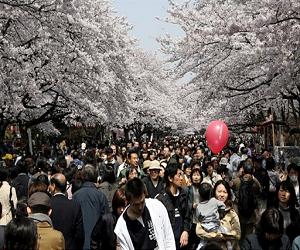
Tokyo (AFP) April 1, 2011 Cherry blossoms, symbols of the fleeting nature of life, are opening in Tokyo but many of the usual boisterous parties will be cancelled as Japan reels from its quake, tsunami and nuclear disasters. In the city's Ueno park, where "sakura" trees will soon bow under the weight of pink and white flowers, people have for centuries celebrated the perfection of nature's short-lived display that heralds the start of spring. But this year, the park won't be making preparations for the usual "hanami" parties for the first time since official celebrations began at the end of World War II, and possibly for the first time in four centuries. "As an expression of our condolences to disaster victims, and of self-restraint, we have decided to cancel the festivities," said Masahiro Kayano, who heads the Ueno district's tourism federation. The notion of self-restraint -- "jishuku" in Japanese -- has come to define the mood in the three weeks since the March 11 disaster struck, leaving more than 28,000 dead and missing and a tsunami-hit nuclear plant still leaking radiation. On TV, many commercials have given way to public service announcements. Companies have delayed product launches, and many neon lights have been switched off amid a national power shortage. Recreational shopping has given way to austerity, and personal consumption will likely fall by more than three trillion yen (36 billion dollars), says Dai-Ichi Life Research Institute chief economist Toshihiro Nagahama. "We need to lift spirits" to revive the consumption that is sorely needed to help an economic recovery, said Ueno's Kayano, adding that Japanese in their collective self-restraint are all "rushing in the same direction". Across the capital, the red-and-white lanterns that would usually be hanging from trees are missing, and signs ask people to refrain from drinking alcohol in public, in stark contrast to the usually boisterous hanami parties, which would normally peak around two weeks from now with trees in full bloom. Bookshop owner Shogo Ono, 59, who has organised annual hanami for his circle of friends for 27 years at Tokyo's Yanaka cemetery, has scrapped the picnic this Saturday, worried a big party would seem inappropriate. "I hesitate to call up my old buddies," he said. The mother of one old friend had "barely survived in Miyagi", the hardest-hit prefecture, and another was helping his daughter whose family shop was destroyed, he said. Besides Ueno, more than half of Tokyo's 79 public parks have cancelled any preparations for cherry blossom festivities, said the metropolitan government's coordinator for public parks, Miyuki Yoshida. The parks are not prohibiting hanami parties, but they won't be taking the usual steps to facilitate them, in part for practical reasons. Many portable toilets, for example, have been sent to the disaster zone, the Ueno official said. Authorities also worry that reduced train services caused by a power shortage won't be able to handle the usual hanami crowds. Tokyo's conservative Governor Ishihara Shintaro set the tone for the capital when he said this week that "just because the cherry trees are blooming doesn't mean we should be drinking and chattering". Ishihara -- controversial for his outspoken nationalist stance and views on wartime Japan -- was heavily criticised after the March 11 disaster when he called the quake and tsunami a "divine punishment" for a greedy society. "This is not the time to be viewing cherry blossoms," the 78-year-old said this week. "It's by sharing the pain of our brethren that a spirit of solidarity is emerging for the first time." In the aftermath of World War II, he added, "everyone restrained themselves. Although Japan had lost, the solidarity of the Japanese at that time was beautiful." Not everyone agrees that a solemn and downbeat mood will help. The hanami cancellations are "very unfortunate since cherry blossoms are Japan's symbol, and parks are losing their merry spirit at a time when they should attract the most visitors," said Yoshida, the Tokyo parks official. Ueno's Kayano said: "If we restrain ourselves too much, the city will die. Not only the earthquake, but the resulting nuclear plant accident and the power shortages are heaping more misery onto an already saddened city."
Share This Article With Planet Earth
Related Links Bringing Order To A World Of Disasters A world of storm and tempest When the Earth Quakes

 Hundreds of bodies in Japan nuclear exclusion zone: report
Tokyo (AFP) April 1, 2011 Up to 1,000 bodies of victims of Japan's quake and tsunami remain uncollected in the exclusion zone around a stricken nuclear plant because of radiation fears, a report said Friday. Citing police sources, Kyodo News said that authorities had intended to transport the bodies outside the 20-kilometre (12-mile) evacuation zone imposed around the Fukushima power station, but were reconsidering t ... read more |
|
|
| The content herein, unless otherwise known to be public domain, are Copyright 1995-2010 - SpaceDaily. AFP and UPI Wire Stories are copyright Agence France-Presse and United Press International. ESA Portal Reports are copyright European Space Agency. All NASA sourced material is public domain. Additional copyrights may apply in whole or part to other bona fide parties. Advertising does not imply endorsement,agreement or approval of any opinions, statements or information provided by SpaceDaily on any Web page published or hosted by SpaceDaily. Privacy Statement |

 del.icio.us
 Digg
Digg Reddit
 YahooMyWeb
 Google
 Facebook







