
 |
 |
 |
 |
 |
 |
 |
 |
 |

 |

Moffett Field CA (SPX) Jan 24, 2011 As NASA's Voyager 2 spacecraft made the only close approach to date of our mysterious seventh planet Uranus 25 years ago, Project Scientist Ed Stone and the Voyager team gathered at NASA's Jet Propulsion Laboratory, Pasadena, Calif., to pore over the data coming in. Images of the small, icy Uranus moon Miranda were particularly surprising. Since small moons tend to cool and freeze over rapidly after their formation, scientists had expected a boring, ancient surface, pockmarked by crater-upon-weathered-crater. Instead they saw grooved terrain with linear valleys and ridges cutting through the older terrain and sometimes coming together in chevron shapes. They also saw dramatic fault scarps, or cliffs. All of this indicated that periods of tectonic and thermal activity had rocked Miranda's surface in the past. The images raised questions about whether or not these small and sometimes active bodies could be targets in the search for habitable environments in the Solar System. The scientists were also shocked by data showing that Uranus' magnetic north and south poles were not closely aligned with the north-south axis of the planet's rotation. Instead, the planet's magnetic field poles were closer to the Uranian equator. This suggested that the material flows in the planet's interior that are generating the magnetic field are closer to the surface of Uranus than the flows inside Earth, Jupiter and Saturn are to their respective surfaces. "Voyager 2's visit to Uranus expanded our knowledge of the unexpected diversity of bodies that share the Solar System with Earth," said Stone, who is based at the California Institute of Technology in Pasadena. "Even though similar in many ways, the worlds we encounter can still surprise us." Voyager 2 was launched on Aug. 20, 1977, 16 days before its twin, Voyager 1. After completing its prime mission of flying by Jupiter and Saturn, Voyager 2 was sent on the right flight path to visit Uranus, which is about 3 billion kilometers (2 billion miles) away from the Sun. Voyager 2 made its closest approach - within 81,500 kilometers (50,600 miles) of the Uranian cloud tops - on Jan. 24, 1986. Before Voyager 2's visit, scientists had to learn about Uranus by using Earth-based and airborne telescopes. By observing dips in starlight as a star passed behind Uranus, scientists knew Uranus had nine narrow rings. But it wasn't until the Voyager 2 flyby that scientists were able to capture for the first time images of the rings and the tiny shepherding moons that sculpted them. Unlike Saturn's icy rings, they found Uranus' rings to be dark gray, reflecting only a few percent of the incident sunlight. Scientists had also determined an average temperature for Uranus (59 Kelvin, or minus 350 degrees Fahrenheit) before this encounter, but the distribution of that temperature came as a surprise. Voyager showed there was heat transport from pole to pole in Uranus' atmosphere that maintained the same temperature at both poles, even though the Sun was shining directly for decades on one pole and not the other. By the end of the Uranus encounter and science analysis, data from Voyager 2 enabled the discovery of 11 new moons and two new rings, and generated dozens of science papers about the quirky seventh planet. Voyager 2 moved on to explore Neptune, the last planetary target, in August 1989. It is now hurtling toward interstellar space, which is the space between stars. It is about 14 billion kilometers (9 billion miles) away from the Sun. Voyager 1, which explored only Jupiter and Saturn before heading on a faster track toward interstellar space, is about 17 billion kilometers (11 billion miles) away from the Sun. "The Uranus encounter was one of a kind," said Suzanne Dodd, Voyager project manager, based at JPL. "Voyager 2 was healthy and durable enough to make it to Uranus and then to Neptune. Currently both Voyager spacecraft are on the cusp of leaving the Sun's sphere of influence and once again blazing a trail of scientific discovery."
Share This Article With Planet Earth
Related Links NASA Voyager Space Tourism, Space Transport and Space Exploration News

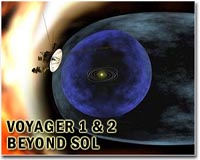 Voyager spacecraft going strong at age 33
Baltimore, Ohio (UPI) Jan 17, 2011 NASA's twin Voyager spacecraft, approaching the edge of the solar system, are still operating and sending back data 33 years after their launch, scientists say. And they are still making news, as researchers announced last month Voyager 1 had outrun the solar wind, the first man-made object to reach the threshold of interstellar space, The Baltimore Sun reported Monday. It's a pe ... read more |
|
|
| The content herein, unless otherwise known to be public domain, are Copyright 1995-2010 - SpaceDaily. AFP and UPI Wire Stories are copyright Agence France-Presse and United Press International. ESA Portal Reports are copyright European Space Agency. All NASA sourced material is public domain. Additional copyrights may apply in whole or part to other bona fide parties. Advertising does not imply endorsement,agreement or approval of any opinions, statements or information provided by SpaceDaily on any Web page published or hosted by SpaceDaily. Privacy Statement |


 del.icio.us
 Digg
Digg Reddit
 YahooMyWeb
 Google
 Facebook







