
 |
 |
 |
 |
 |
 |
 |
 |
 |

 |

Washington (UPI) Oct 12, 2010 The race to develop technological capability to detect any potential threat of nuclear terrorism received additional funding Tuesday amid industry warnings the dangers of unpredictable enemy acts remain present. Dynasil Corp. of America said it was pledged a $2 million additional U.S. Department of Homeland Security award to advance nuclear detection capabilities. Dynasil said the Domestic Nuclear Detection Office of the U.S. Department of Homeland Security is allocating the funds to its subsidiary, Radiation Monitoring Devices, Inc. The money will go toward funding advancement of new high-performance nuclear threat detector materials that are potentially important additions to the United States' homeland security arsenal. The company says its scintillator materials represent a leap forward in radiation detection performance that can have military, industrial and medical uses. Dynasil's crystal scintillator, optically coupled with a photodetector, converts radiation to visible light to detect radiation and dangerous nuclear materials that could be used in a "dirty" bomb or a nuclear device. Despite financial constraints of current economic conditions, both administration and industry leaders have put emphasis on detection of hostile nuclear materials. Additional programs have concentrated on detecting anthrax and other dangerous substances. The crystal scintillator is highly sensitive and can differentiate between a broad range of threatening and non-threatening materials, thus reducing false negatives, said the company. Recent research has focused on the risk of terrorists smuggling nuclear material into the United States to create a weapon of mass destruction. Dynasil described it as "one of the most serious threats faced by the United States." In the meantime, government security measures have involved preventive measures to remove the possibility of terrorists "acquiring radioactive materials that would allow them to fabricate a nuclear weapon," Dynasil said. A major component of the effort involves outfitting border crossings and shipping ports in the United States and overseas with improved detection equipment that can detect radiation. While current nuclear detection technology utilizes helium 3, a byproduct of the earlier U.S. nuclear weapons programs that is increasingly in short supply, Dynasil's new "dual mode" detectors are designed to work without helium 3 and can replace two separate nuclear detector systems for gamma radiation and for the neutrons from nuclear materials. The government will cover a $1.3 million contract to enable the company to deliver the "dual mode" detector materials, optimized for quick identification of multiple radiation sources simultaneously, including highly enriched uranium, plutonium and other radioactive materials. Part of the funding will go toward research and development work on five new materials for nuclear threat detection. Craig Dunham, Dynasil's president and chief executive officer, said the new technology may provide better tools to detect and intercept potentially devastating weapons. He said the company's work on nuclear detection products would enhance its growth while delivering "a higher level of safety to U.S. people and the community." Dynasil Corp. has operations in New Jersey, New York, Massachusetts and the U.K. Radiation Monitoring Devices, Inc. is a wholly owned Dynasil subsidiary with offices in Watertown, Mass.
Share This Article With Planet Earth
Related Links Learn about nuclear weapons doctrine and defense at SpaceWar.com Learn about missile defense at SpaceWar.com All about missiles at SpaceWar.com Learn about the Superpowers of the 21st Century at SpaceWar.com

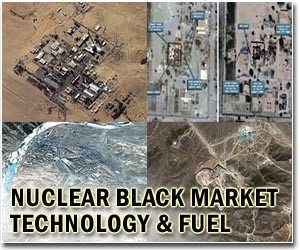
 Iran to show proof of US nuclear aid to Israel: negotiator
Tehran (AFP) Oct 11, 2010 Iran's top nuclear negotiator Saeed Jalili said on Monday that Tehran is to reveal proof of how nuclear material enriched by United States was delivered to the Islamic republic's arch-foe Israel. "We will soon publish documents on how American enriched nuclear material was provided and transported to the Zionist regime," Jalili said, quoted on state television's website. Jalili said the ... read more |
|
|
| The content herein, unless otherwise known to be public domain, are Copyright 1995-2010 - SpaceDaily. AFP and UPI Wire Stories are copyright Agence France-Presse and United Press International. ESA Portal Reports are copyright European Space Agency. All NASA sourced material is public domain. Additional copyrights may apply in whole or part to other bona fide parties. Advertising does not imply endorsement,agreement or approval of any opinions, statements or information provided by SpaceDaily on any Web page published or hosted by SpaceDaily. Privacy Statement |

 del.icio.us
 Digg
Digg Reddit
 YahooMyWeb
 Google
 Facebook







