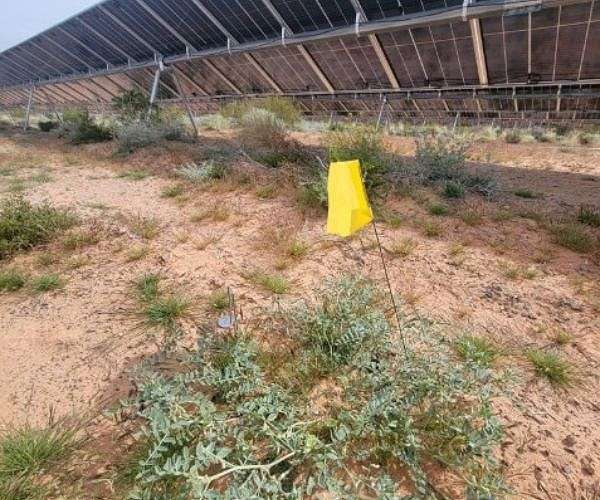
Surveys at one of the largest solar energy facilities in the Mojave Desert indicate that a rare annual plant is not only persisting but flourishing under a construction approach designed to preserve desert soils and seedbanks. Researchers monitoring the Gemini Solar Project northeast of Las Vegas documented a sharp increase in the number and size of threecorner milkvetch plants two years after panel installation compared with preconstruction conditions.
The work, led by ecologist Tiffany Pereira of the Desert Research Institute (DRI), is detailed in a study published in Frontiers in Ecology and Evolution in late November 2025. The team revisited plots within the Gemini Solar Project footprint that had been surveyed before construction began in 2018, focusing on the rare threecorner milkvetch, a member of the pea family that is being considered for listing under the U.S. Endangered Species Act.
In 2018, surveyors documented 12 individual threecorner milkvetch plants on the project site prior to construction activity. When Pereira and colleagues returned in 2024, they counted 93 plants within the same project area, indicating that the soil seedbank survived disturbance and that the species rebounded numerically after installation of the solar array.
"We were curious to see how the seed bank would be impacted by the construction," Pereira said. "What we found was that not only did the seed bank survive, but the plant came up. And these were big plants, they were larger in every metric we measured – width, height, number of flowers and fruits, leaf length – than the plants that we measured off the site. That was really cool and surprising."
To separate the effects of construction from natural variability in rainfall, the team compared plants growing within the Gemini facility to individuals at a nearby undisturbed reference site. By examining two populations that experienced the same regional weather, the researchers could attribute differences in plant performance to the presence of the solar infrastructure and associated microclimate changes rather than to year-to-year precipitation shifts alone.
The Gemini Solar Project differs from many utility-scale arrays in the arid Southwest because builders did not simply "blade and grade" the site by scraping away vegetation and topsoil before installing panels. Conventional blade and grade methods clear the ground, remove shrubs and biological soil crusts, and destroy the upper soil layers that hold long-lived seeds, making natural recovery difficult or impossible even when rainfall is favorable.
Instead, Gemini adopted a lower-impact construction strategy that sought to retain existing desert surfaces and biological resources where feasible. The study notes that this approach appears to have preserved the threecorner milkvetch seedbank across much of the site, allowing the species to emerge after construction and take advantage of altered soil moisture patterns beneath and around the panel arrays.
Threecorner milkvetch is considered rare throughout its limited range and has been categorized by Nevada as Critically Endangered and Fully Protected. The U.S. Bureau of Land Management lists it as a Special Status Species. As an annual, the plant spends most of its life cycle as dormant seed in the soil, emerging above ground only in years when rainfall patterns provide sufficient moisture for germination, growth and reproduction.
Because of this life history strategy, populations can appear to vanish in dry years and then reappear in large numbers when wetter conditions return. The researchers suggest that the higher growth rates observed at Gemini may be linked to the way the solar installation affects soil water retention. Sensors and field observations indicate that soils within the project area hold moisture longer after storms than soils at the undisturbed comparison site.
"Subsequent years of monitoring will help us unpack this," Pereira said, "but the soil moisture content on Gemini is higher after rainfall events. The water is retained in the ground for longer after rainstorms, so it takes longer to dry out. The plants might just be soaking up that extra water."
Although threecorner milkvetch individuals within the project boundary were larger on average than those outside, the team recorded only a single plant growing directly in the shaded zone beneath a solar panel. Most individuals occurred in the open strips of ground between panel rows, suggesting that the species may have specific light or microhabitat requirements that are not met under continuous panel cover.
This pattern points to potential tradeoffs even under more sustainable construction practices. While careful surface protection can allow rare plant seedbanks to survive, the footprint of the array still reduces the amount of fully suitable habitat. The study recommends additional experiments, including controlled germination trials, to test whether shading or other physical aspects of the array limit seedling emergence and survival under panels.
Pereira emphasizes that the 2024 survey represents only one year of postconstruction monitoring and cautions against drawing long-term conclusions from a single season. Under desert conditions, populations of annual plants can fluctuate by orders of magnitude depending on rainfall timing and intensity, so multiple years of data will be needed to confirm whether Gemini continues to support robust threecorner milkvetch populations.
"Our main goal for land managers is always avoidance," she said. "When it comes to rare plant habitat, avoid if possible, and then these alternative construction methods can be used to preserve habitat in areas where it can't be avoided." The Gemini results, she added, show that less disruptive approaches can provide a compromise where complete avoidance is not realistic.
The findings feed into a broader debate over how to expand renewable energy infrastructure across the American Southwest without erasing the very landscapes that define the region. Many conservationists have warned that rapid build-out of utility-scale solar threatens fragile desert ecosystems, especially where blade and grade removes vegetation, topsoil and cryptobiotic crusts across hundreds or thousands of hectares.
By demonstrating that at least one rare species can persist and even thrive under a large solar array built with seedbank-friendly methods, the Gemini study offers a more hopeful template. It suggests that with advance planning, careful surface management and ongoing monitoring, land managers can capture the benefits of fossil fuel-free power while maintaining ecological function and some of the biodiversity value of intact desert habitat.
"Our desert species are amazing," Pereira said. "These seedbanks can withstand a lot – they persist in the soil for years, just waiting for the right conditions to germinate, and now we know that they can even survive through more gentle construction methods. With a little ingenuity, we can address both habitat and renewable energy concerns. These things can work together."
Research Report: Rare milkvetch (Astragalus) persistence at a utility-scale solar energy facility in the Mojave Desert