|
 |
 |
 |
 |
 |
 |
 |
 |

 |
Russia's New Research Station In Arctic To Open In Late September
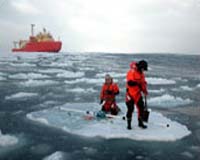
St Petersburg (RIA Novosti) Aug 21, 2007 Russia's new drifting research station in the Arctic will begin working in late September, the press spokesman of the Artic and Antarctic Research Institute said Monday. The North Pole 35 station being set up with the help of the Akademik Fedorov research vessel and the nuclear icebreaker Rossiya, which brought mini-submarines to the pole for the first ever dive to the seabed earlier in August, will conduct research in the area for one year and replace the previous station. Sergei Balyasnikov said about 20 Russian and German scientists will conduct geological and ornithological research on an ice floe in the East Siberian Sea located between the Arctic Cape in the north and Siberia's coast in the south. In early August, Russian researchers descended 4,200 meters (14,000 feet) below the Pole in two submersibles to gather scientific evidence to bolster the country's claim to a vast swathe of extra Arctic territory and planted a titanium Russian flag on the seafloor. The mission attracted criticism from rival Arctic nations. Under international law, the five Arctic Circle countries - the U.S., Canada, Denmark, Norway and Russia - each have a 322-kilometer (200-mile) economic zone in the Arctic Ocean at the moment.
Source: RIA Novosti Related Links Artic and Antarctic Research Institute Beyond the Ice Age
 Student Joins AMASE Expedition In Svalbard
 Svalbard, Denmark (SPX) Aug 20, 2007
For two weeks, an international crew of scientists and engineers are field-testing instruments for future Mars missions. Thea Falkenberg, winner of a student contest to join the AMASE expedition, reports back on her experiences through a daily blog. The Arctic Mars Analog Svalbard Expedition (AMASE) takes advantage of similarities between the conditions on Mars and those at Svalbard in order to do scientific research in preparation future Mars missions, such as ESA's ExoMars and NASA's Mars Science Laboratory. |
|
|

| The content herein, unless otherwise known to be public domain, are Copyright Space.TV Corporation. AFP and UPI Wire Stories are copyright Agence France-Presse and United Press International. ESA Portal Reports are copyright European Space Agency. All NASA sourced material is public domain. Additional copyrights may apply in whole or part to other bona fide parties. Advertising does not imply endorsement, agreement or approval of any opinions, statements or information provided by Space.TV Corp on any Web page published or hosted by Space.TV Corp. Privacy Statement |