|
 |
 |
 |
 |
 |
 |
 |
 |

 |
Satellite Data Provide New View Of Smoke From Wildfires
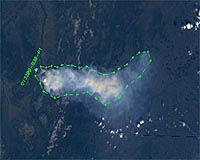
Pasadena CA (SPX) Feb 26, 2009 Scientists have a new tool for understanding how events in one region, such as wildfires, can affect air quality in areas far away. Observations from NASA's Multi-angle Imaging SpectroRadiometer (MISR) show that the plumes of dust, smoke and particles from wildfires or volcanoes often rise past the atmospheric boundary layer, the turbulent lowest portion of the atmosphere, and are injected into the less-turbulent and higher free troposphere. The aerosols can remain concentrated there for long periods and also be transported great distances. The MISR Plume Height Climatology Project, a repository for wildfire plume height data acquired with MISR, became publically available in early 2008 and supports studies of wildfires, climate change and air quality. The MISR INteractive eXplorer (MINX) application tool used to generate the database is also free and was the recipient of a 2008 NASA Space Act Board Award. One of the project's goals is to generate data based on actual observations of biomass burning emissions from wildfires that can be used in global atmospheric models. The frequency of wildfires has increased over the past few decades, and such fires may be even more common in a future, warmer climate. Predicting the effects of climate change on air quality requires the ability to accurately model smoke injection and long-range transport. The MISR instrument flies on NASA's Terra satellite. Related Links MISR Earth Observation News - Suppiliers, Technology and Application
 Orbital's Launch Of Taurus Rocket Is Unsuccessful
 Dulles VA (SPX) Feb 25, 2009
Orbital Sciences has announced that the launch of its Taurus XL rocket, which lifted off at 4:55 a.m. (EST) from Vandenberg Air Force Base, CA., carrying the company-built Orbiting Carbon Observatory satellite for NASA, did not achieve orbit. |
|
|

| The content herein, unless otherwise known to be public domain, are Copyright Space.TV Corporation. AFP and UPI Wire Stories are copyright Agence France-Presse and United Press International. ESA Portal Reports are copyright European Space Agency. All NASA sourced material is public domain. Additional copyrights may apply in whole or part to other bona fide parties. Advertising does not imply endorsement, agreement or approval of any opinions, statements or information provided by Space.TV Corp on any Web page published or hosted by Space.TV Corp. Privacy Statement |