
 |
 |
 |
 |
 |
 |
 |
 |

| . |  |
. |

|
|
. |

 by Staff Writers Madrid, Spain (SPX) Jul 21, 2011
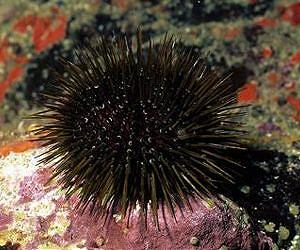
Exotic marine species, including giant seaweeds, are spreading fast, with harmful effects on native species, and are increasingly affecting the biodiversity of the Mediterranean seabed. Some native species, such as sea urchins (Paracentrotus lividus), can fight off this invasion, but only during its early stages, or when seaweed densities are very low. Spanish researchers have carried out a study to look at the ability of sea urchins (Paracentrotus lividus) - generalist herbivores that live in the Mediterranean - to limit the invasion of two introduced seaweeds (Lophocladia lallemandii and Caulerpa racemosa), which are having a "grave" effect on the seabed. "After seven months of experimentation, we found that predation by these herbivores had no effect once Caulerpa racemosa was completely established, although it did reduce the degree to which it became established in the very early stages of invasion", Emma Cebrian, lead author of the study and a researcher in the Department of Environmental Sciences at the University of Girona, tells SINC. In the case of Lophocladia lallemandii, the sea urchins were able to limit the seasonal spread of the seaweed. "Since the amount of this species directly consumed by the sea urchins is very low, this reduction was due more to the decline in other native species (consumed by the sea urchins), which act as a substrate for the seaweed", the expert explains. The research, which has been published in Biological Invasions, shows that, although high sea urchin densities can have a limiting effect on the establishment of invasive seaweeds, "they exert no control whatsoever in highly invaded areas", the researcher adds.
Sea urchins on the attack Although the two species of invasive seaweed are very abundant in the environment, "Lophocladia lallemandii was consumed to a very low degree, while the sea urchins displayed a certain preference for eating Caulerpa racemosa", the biologist goes on. To find out whether consumption by the sea urchins could control the invasion by these two species, the team of researchers placed large numbers of sea urchins into cages (12 sea urchins/m2) and monitored how the invasive seaweeds developed. The cages were placed in areas completely invaded by C. racemosa (established invasion), in areas where the invasion was still very limited (initial stages of invasion) and in places where L. lallemandii was very abundant. "The sea urchins only controlled the expansion of C. racemosa in the cages in places where the invasion was still at a very early stage", Cebrian points out. The research team says it would "be of great interest" to study possible mechanisms for controlling these invasions, and the resistance of native communities to them, given the growing impact of exotic species. Cebrian, Emma; Ballesteros, Enric; Linares, Cristina; Tomas, Fiona. "Do native herbivores provide resistance to Mediterranean marine bioinvasions? A seaweed example" Biological Invasions 13(6): 1397-1408, June 2011.
|
. |
|
| The content herein, unless otherwise known to be public domain, are Copyright 1995-2011 - Space Media Network. AFP and UPI Wire Stories are copyright Agence France-Presse and United Press International. ESA Portal Reports are copyright European Space Agency. All NASA sourced material is public domain. Additional copyrights may apply in whole or part to other bona fide parties. Advertising does not imply endorsement,agreement or approval of any opinions, statements or information provided by Space Media Network on any Web page published or hosted by Space Media Network. Privacy Statement |
 del.icio.us
 Digg
Digg Reddit
 Google








