|
 |
 |
 |
 |
 |
 |
 |
 |

 |
Search For Life In Martian Ice Relies On UK Technology
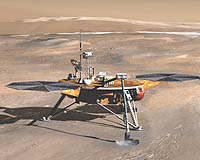
London UK (SPX) Jul 26, 2007 The Martian surface will be explored for conditions favourable for past or present life thanks to micro-machine technology supplied by Imperial College London. The NASA mission, planned for August 2007, represents the first chance for UK hardware to contribute to the exploration of Mars since the failed Beagle 2 spacecraft launched in 2003. Dr Tom Pike and his team at Imperial's Department of Electrical and Electronic Engineering have provided substrates-surfaces used to hold samples for imaging-for the Mars Phoenix mission. These substrates will hold dust and soil for examination in a microscope station attached to the Phoenix lander. The grains of Martian dust and soil, delivered by a mechanical excavating arm, will be imaged by an optical microscope and an atomic force microscope. Together they will provide the highest resolution of imaging ever taken on another planet. "Nobody has looked at Mars at this type of resolution. It is very difficult to predict what we might find, but if you wanted to look for the earliest forms of past or present life we will be the first to look closely enough," said Dr Pike. The team has been conducting trials on a replica of Phoenix's microscope station based at Imperial. They have been using the equipment for several months to work out the best way of studying the Martian soil. They also visited Mission Control at the University of Arizona Tucson USA (14-20 July 2007). As part of the "operational readiness" process Dr Pike and his colleagues spent a week going through a simulation of the actual mission. The launch date is scheduled for a three-week period after 3 August 2007. The aim of the NASA mission is to search for potential biological habitable zones. The Phoenix lander is scheduled to touch down on the northern ice-rich polar region known as the Vastitas Borealis. The mission represents the first attempt to actually touch and analyse Martian water in the form of buried ice. The spacecraft will investigate whether frozen water near the Martian surface might periodically melt enough to sustain a habitable zone for primitive microbes. If Phoenix lands successfully scientists will have three months to complete their tasks. They will race against the clock to dig for, and analyse, materials before the Martian winter sets in and the solar panels no longer provide enough power to run the vehicle. During the analysis phase Dr Pike and his team will be based at Mission Control. They will be part of the team operating the microscope station. The construction of the microscope station is an international collaboration with contributions from the U.S., Switzerland, Demark and the UK. The UK involvement is supported by the Science and Technology Facilities Council. "This is the first chance since the Beagle mission that the UK will be able to help explore the surface of Mars. It is great to have the resources and the people at Imperial to enable us to take part in this mission," said Dr Pike. Related Links Imperial College London Mars News and Information at MarsDaily.com Lunar Dreams and more
 Seeking Mars Survival Secrets
 Princeton NJ (SPX) May 23, 2007
David Smith always wondered whether other planets might harbor life, so when he actually got the opportunity to investigate, he jumped at it. His decision launched him on a year-long mission, leading him to the Kennedy Space Center and back. Now, after long months exploring whether Earth bacteria can survive on the surface of Mars, he has returned with findings that could help NASA plan better missions to the red planet, and may even get his senior thesis published in a scientific journal. |
|
|

| The content herein, unless otherwise known to be public domain, are Copyright Space.TV Corporation. AFP and UPI Wire Stories are copyright Agence France-Presse and United Press International. ESA Portal Reports are copyright European Space Agency. All NASA sourced material is public domain. Additional copyrights may apply in whole or part to other bona fide parties. Advertising does not imply endorsement, agreement or approval of any opinions, statements or information provided by Space.TV Corp on any Web page published or hosted by Space.TV Corp. Privacy Statement |