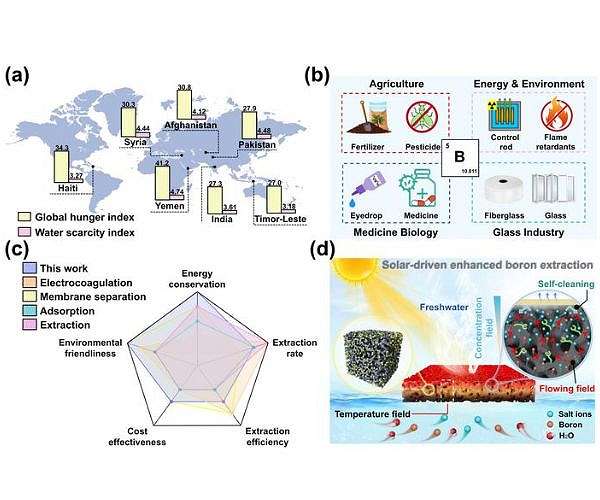
A study published in Science Bulletin describes a solar-driven system that produces freshwater while capturing boron from seawater and brine using a composite gel identified as (MXene-MgO)@sodium alginate (MMS). The work targets the interlinked pressures on water, food, and energy supplies in regions such as Yemen, Pakistan, and Haiti, where demand is rising and water scarcity and hunger are severe. Conventional desalination can supply drinking water, but standard processes often fail to meet World Health Organization limits on boron in potable water and usually discard boron instead of recovering it as a resource.
To address these constraints, the team incorporated MgO, which acts as a boron adsorbent, and MXene, which serves as both a photothermal material and an auxiliary boron adsorbent, into a sodium alginate matrix to form the MMS composite gel. Under one sun illumination, this material achieved an evaporation rate of 2.14 kilograms per square meter per hour and a boron adsorption capacity of 225.52 milligrams per square meter over nine hours. These results indicate that the MMS gel can both desalinate seawater and significantly reduce boron levels in a single integrated step.
The MMS gel features a hierarchical porous structure that enhances water transport and provides a large internal surface for light absorption and ion interaction. MXene nanosheets absorb a broad spectrum of sunlight and convert it into heat at the water – air interface, while MgO nanoparticles dispersed in the matrix act as active sites for binding boron species. The design exploits coupled temperature, concentration, and flow fields within the gel to accelerate boron adsorption kinetics, improving overall separation efficiency.
Outdoor trials supported the laboratory findings, with MMS modules producing 5.20 kilograms per square meter of freshwater per day while recovering 122.45 milligrams per square meter of boron. When applied to agriculture, the recovered boron increased the seed germination rate of Brassica juncea by 13 percent and approximately tripled biomass compared with boron-deficient controls. The authors report that this desalination-coupled boron extraction approach offers a relatively simple and resource-conserving route for coastal regions with limited freshwater and boron-deficient soils.
Research Report:Solar-driven multi-field synergistic harvesting of freshwater and boron from seawater by (MXene-MgO)@sodium alginate composite gel