|
 |
 |
 |
 |
 |
 |
 |
 |

 |
Taming A Volcano With Macro-Scale Chemical Engineering
Olney UK (SPX) Jun 08, 2008 Could macro-scale chemical engineering be used to stop a volcanic lava flow in its tracks and save potentially thousands of lives and homes when the next eruption occurs? That's the question R.D. Schuiling of Geochem Research BV, based in The Netherlands, asks in the current issue of the Inderscience Publication, International Journal of Global Environmental Issues. During the 1960s, Schuiling pioneered the discipline of geochemical engineering, which involves the use of natural processes to solve environmental and civil engineering problems. He recently turned his attention to the ongoing problem of how to tame volcanic lava flows. Lava flows regularly threaten and sometimes destroy human settlements. In 1973, the Icelanders had some success slowing the advance of lava from Heimaey by dousing the flow with huge volumes of seawater. Meanwhile in Sicily, the town of Zafferana was saved from being ravaged by the 1991-1993 eruption cycle of Etna by huge earth walls built to divert the lava flow. Schuiling believes a geochemical approach might be effective in controlling lava flows across the globe. He explains that certain common rocks, namely dolomite, or limestone, will react strongly with hot lava at 1100-1200 Celsius. The chemical reaction that ensues is highly endothermic, which means it requires heat, and this would be supplied by the hot lava. The decarbonation of limestone by the hot lava will therefore rapidly cool the volcanic outpourings, making it far more viscous and quicker to solidify. The reaction will leave behind solid calcium and magnesium oxide mixtures - pyroxenes or melilites depending on the specific type of lava. The process would also release some carbon dioxide. He suggests that large chunks of dolomite or limestone blocks could be thrown on to lava from the sides, or from above by helicopters or airplanes, or even by an aerial cable system passing over the flow. An alternative approach might be to quickly build a wall of limestone blocks in the path of the advancing lava flow. In places where a future lava flow would cause great material damage, such walls could even be constructed as a forward defense before a new eruption. "How to stop or slow down lava flows" by R.D. Schuiling in Int. J. Global Environmental Issues, 2008, 8, 282-285 Related Links Inderscience Publishers Bringing Order To A World Of Disasters When the Earth Quakes A world of storm and tempest
 Volcano erupts in Indonesia
 Jakarta (AFP) June 6, 2008
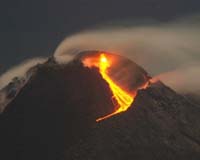
A volcano erupted on Indonesia's Sulawesi island Friday, spewing smoke and sending heat clouds of debris down its slopes, a volcanologist said. |
|
|

| The content herein, unless otherwise known to be public domain, are Copyright Space.TV Corporation. AFP and UPI Wire Stories are copyright Agence France-Presse and United Press International. ESA Portal Reports are copyright European Space Agency. All NASA sourced material is public domain. Additional copyrights may apply in whole or part to other bona fide parties. Advertising does not imply endorsement, agreement or approval of any opinions, statements or information provided by Space.TV Corp on any Web page published or hosted by Space.TV Corp. Privacy Statement |