
Solar Energy News
SOLAR DAILY
Theory links photon condensation and heat engine physics
illustration only

Theory links photon condensation and heat engine physics

by Sophie Jenkins
London, UK (SPX) Jan 13, 2026

Physicists at Trinity College Dublin have developed a new theoretical framework that connects photon condensation in optical microstructures with the fundamental limits of heat engines, potentially offering new routes to harvest more useful energy from sunlight and other light sources. The work suggests that devices which trap light in tiny cavities could concentrate diffuse radiation into laser-like beams without requiring an incoming laser, opening a path to turn disorganised heat into ordered optical work.

In their analysis, the team considered photons confined within microscopic optical devices, where the particles of light can behave collectively rather than as independent quanta. Under the right conditions this collective behaviour leads to a form of condensation, in which light energy is funneled into a small, intense beam of a single pure colour that closely resembles laser output.

Previous experiments had demonstrated such photon condensation, but only when the input energy already arrived in a highly concentrated, coherent form provided by a laser. The new theory indicates that similar condensation should be achievable when the input is diffuse, such as the broad spectrum radiation from sunlight, conventional lamps, or LEDs, provided that the optical cavity and its environment are engineered appropriately.

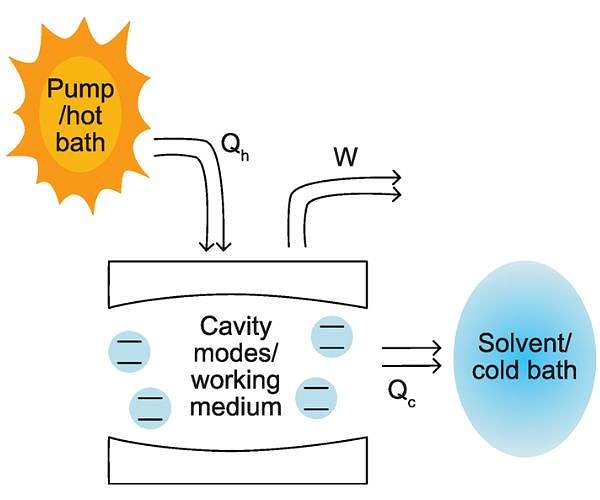
Senior author Paul Eastham, Naughton Associate Professor in Trinity's School of Physics, explains that the behaviour of these light-trapping devices can be understood using the same thermodynamic principles that govern classical heat engines. By treating the trapped photons and their environment as a heat engine, the researchers show that the onset of photon condensation is controlled by the laws that also limit the performance of steam engines and power plants, linking optical condensation thresholds to fundamental constraints on converting heat into work.

This conceptual bridge means that design rules for efficient heat engines can inform the design of optical structures that channel light energy at the quantum level. According to the researchers, such insight could guide the development of micro- and nano-scale devices that steer energy flow in photonic circuits, solar energy technologies, and microscopic engines powered directly by radiation instead of mechanical fuel.

First author Luisa Toledo Tude, also from Trinity's School of Physics, notes that the primary aim of these optical devices is to transform incoming radiation into a more useful form of energy output. In the scenarios considered, that useful output appears as laser-like light that can be converted relatively easily into electricity, mechanical motion, or other forms of work depending on the application.

One potential application highlighted by the team is the integration of photon-condensation cavities with conventional solar cells. In such a hybrid system, a device that concentrates diffuse sunlight into a narrow-band, high-intensity beam could feed a photovoltaic element more effectively than direct illumination, increasing the fraction of incident solar energy captured as electrical power.

Beyond photovoltaics, the same principles could enable miniature radiation-driven engines where ordered optical fields drive mechanical or electronic processes on microscopic scales. These devices might harvest ambient light from indoor sources such as lamps and LEDs, repurposing it to perform useful work in low-power sensor networks or quantum technologies.

The research, supported by funding from Research Ireland, appears in the journal Physical Review A. The authors emphasise that the present work is theoretical and that the next step is to test the predictions experimentally in the laboratory, where real optical materials, cavity imperfections, and environmental noise will determine how closely practical devices can approach the idealised behaviour described in their models.

Although the scientists caution against over-speculation, they recognise that validating this theory could broaden the toolbox for managing light as an energy resource. In the longer term, advances in controlling photon condensation using heat-engine concepts may contribute to technologies that extract more useful work from sunlight and artificial illumination, helping to power the vast number of devices and processes that depend on reliable energy flows.

Research Report:Photon condensation from thermal sources and the limits of heat engines

Related Links
Trinity College Dublin
All About Solar Energy at SolarDaily.com

Subscribe Free To Our Daily Newsletters
Tweet

RELATED CONTENT
The following news reports may link to other Space Media Network websites.
SOLAR DAILY
Osmium dye boosts long wavelength solar hydrogen output
Tokyo, Japan (SPX) Jan 09, 2026
Generating hydrogen from sunlight offers a route to low carbon fuel production by converting solar energy into chemical energy stored in hydrogen. Researchers use photocatalysts to absorb light and drive water splitting into hydrogen and oxygen, but many existing systems only harvest part of the visible spectrum, leaving much of the incoming solar energy unused. To increase solar-to-hydrogen efficiency, researchers are investigating photocatalysts that respond to a broader range of visible wavelengths. ... read more

SOLAR DAILY
Carbon monoxide enables rapid atomic scale control for fuel cell catalysts

Singapore sets course for 'green' methanol ship fuel supplies

Methane conversion enabled by iron catalyst delivers pharmaceutical compounds

Illinois team creates aviation fuel from food waste with circular economy benefits

SOLAR DAILY
EU orders Musk's Grok AI to keep data after nudes outcry

Dancing isn't enough: industry pushes for practical robots

Brew, smell, and serve: AI steals the show at CES 2026

Startups go public in litmus test for Chinese AI

SOLAR DAILY
Trump gets wrong country, wrong bird in windmill rant

S.Africa seeks to save birds from wind turbine risks

Vertical wind turbines may soon power UK railways using tunnel airflow

SOLAR DAILY
GM announces $7.1 bn hit to profits on electric auto pullback

EV sales rebound in Germany as Chinese brands make inroads

Tesla loses EV crown to China's BYD in 2025 as sales slip

Norway closes in on objective of 100% electric car sales

SOLAR DAILY
Physicists map axion production paths inside deuterium tritium fusion reactors

Chitin based carbon aerogel boosts stable thermal energy storage

Molecular catalyst switches between hydrogen and oxygen production

China's rare earths El Dorado gives strategic edge

SOLAR DAILY
Meta partners with US nuclear companies to power AI data centers

Japan nuclear official loses phone with confidential data in China

Microbes join forces to quickly clean up uranium pollution

Crown ether resins modeled for precise gadolinium isotope separation

SOLAR DAILY
Chinese villagers struggle for heat as gas subsidies fade

UN climate chief says Trump scores 'own goal' with treaty retreat

German climate goals at risk as emissions cuts slow: study

France updates net-zero plan, with fossil fuel phaseout; Fight over fossil fuels nixes key text of UN environment report

SOLAR DAILY
Indonesia to revoke 22 forestry permits after deadly floods

How deforestation turbocharged Indonesia's deadly floods

In blow to Lula, Brazil Congress revives controversial environmental bill

Restoration potential on urban fringes identified in Brazil

Subscribe Free To Our Daily Newsletters


The content herein, unless otherwise known to be public domain, are Copyright 1995-2024 - Space Media Network. All websites are published in Australia and are solely subject to Australian law and governed by Fair Use principals for news reporting and research purposes. AFP, UPI and IANS news wire stories are copyright Agence France-Presse, United Press International and Indo-Asia News Service. ESA news reports are copyright European Space Agency. All NASA sourced material is public domain. Additional copyrights may apply in whole or part to other bona fide parties. All articles labeled "by Staff Writers" include reports supplied to Space Media Network by industry news wires, PR agencies, corporate press officers and the like. Such articles are individually curated and edited by Space Media Network staff on the basis of the report's information value to our industry and professional readership. Advertising does not imply endorsement, agreement or approval of any opinions, statements or information provided by Space Media Network on any Web page published or hosted by Space Media Network. General Data Protection Regulation (GDPR) Statement Our advertisers use various cookies and the like to deliver the best ad banner available at one time. All network advertising suppliers have GDPR policies (Legitimate Interest) that conform with EU regulations for data collection. By using our websites you consent to cookie based advertising. If you do not agree with this then you must stop using the websites from May 25, 2018. Privacy Statement. Additional information can be found here at About Us.