|
 |
 |
 |
 |
 |
 |
 |
 |

 |
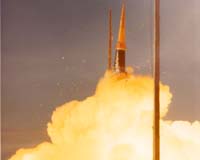
US missile defense system scores intercept in test
Washington (AFP) Sept 28, 2007 A US missile intercepted a mock warhead launched into space over the Pacific Friday in a successful test of the US missile defense system, a defense spokesman said. "It was a direct hit," said Chris Taylor, a spokesman for the Pentagon's Missile Defense Agency. The interceptor missile was launched from Vandenberg Air Force Base in California 17 minutes after the target missile was launched from Kodiak Island in Alaska, he said. A "kill vehicle" deployed by the interceptor missile collided at 2024 GMT with a mock warhead boosted into space by the target missile. It was the seventh successful intercept since the Pentagon started the missile tests in 1999. There have been 12 intercept tests since the start of the program, of which four were failures. A test in May was declared a "non test" when the target missile failed to launch. Each test costs about 100 million dollars. Friday's test was the first flight test in a year in which the primary objective was to intercept a target warhead in space. The interceptor missile is guided into the path of the incoming long-range missile warhead. It then releases a "kill vehicle" that is designed to seek out and steer itself into a collision with the warhead. MDA officials said an early warning radar at Beale Air Force Base in California tracked the target missile from the time of its launch at 2001 GMT. A key objective of the test was to show that the recently upgraded radar at Beale was able to acquire, track and relay tracking data on the target. Military crews manning missile defense command centers were not told what time the target launch would occur, so they had to rely on data from the radar and other sensors to detect, track and target the missile. The target warhead also was tracked by a huge floating X-Band radar in the Pacific and by a US Aegis warship with an onboard targeting radar. "Program officials will evaluate system performance based upon telemetry and other data obtained during the tests," the Pentagon said in a statement. Related Links Learn about missile defense at SpaceWar.com Learn about nuclear weapons doctrine and defense at SpaceWar.com All about missiles at SpaceWar.com Learn about the Superpowers of the 21st Century at SpaceWar.com
 US interceptors in Europe fast enough to hit Russian ICBMs: researcher
 Washington (AFP) Sept 27, 2007
Interceptor missiles deployed in Poland as part of a US missile defense shield would be fast enough to target Russian intercontinental missiles, contrary to US assurances, a US researcher said Thursday. |
|
|

| The content herein, unless otherwise known to be public domain, are Copyright Space.TV Corporation. AFP and UPI Wire Stories are copyright Agence France-Presse and United Press International. ESA Portal Reports are copyright European Space Agency. All NASA sourced material is public domain. Additional copyrights may apply in whole or part to other bona fide parties. Advertising does not imply endorsement, agreement or approval of any opinions, statements or information provided by Space.TV Corp on any Web page published or hosted by Space.TV Corp. Privacy Statement |