|
 |
 |
 |
 |
 |
 |
 |
 |

 |
What Lies Beneath
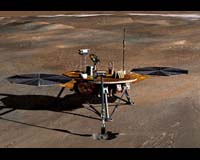
Fayetteville AK (SPX) Mar 19, 2007 Studies conducted by University of Arkansas researchers suggest locations where future Mars missions might seek liquid water underneath Martian soil. Graduate students Kathryn Bryson and Daniel Ostrowski, postdoctoral researcher Vincent Chevrier and Derek Sears, director of the Arkansas Center for Space and Planetary Sciences, will present their findings Friday, March 16, at the Lunar and Planetary Sciences conference in Houston. The researchers used a planetary environmental chamber to simulate conditions found on Mars - a carbon dioxide atmosphere, 7 millibars of pressure and temperatures near zero degrees Celsius. Bryson looked at the evaporation rates of ice buried beneath fine-grained basaltic soil at depths of 2.5 to 50 millimeters. "Soil layers only 5 millimeters deep slowed the evaporation process and greatly increased the lifetime of an ice layer," Bryson said. A soil barrier on top of an ice layer can enable the formation of liquid water by slowing the evaporation rate and warming the surface. Ostrowski examined the evaporation rates of ice beneath montmorillonite, an aluminum-rich clay recently shown to be present on Mars. Montmorillonite is a hydrated clay that requires the presence of water in some form for its creation. Studies of the clay soil indicate that the diffusion rate doesn't become steady as quickly as other non-clay materials do, possibly indicating that the clay is adsorbing water, either in liquid or gas form. "This does not directly imply liquid water, but it does give the possibility if the conditions are right," Ostrowski said. The upcoming Mars Phoenix Lander mission will be looking for environments similar to those investigated in these experiments, and scientists hope to find evidence for water - and possibly life -- in these regions. The Arkansas Center for Space and Planetary Sciences is a joint center in the J. William Fulbright College of Arts and Sciences and the College of Engineering. Related Links Arkansas Center for Space and Planetary Sciences Mars News and Information at MarsDaily.com Mars News and Information at MarsDaily.com Lunar Dreams and more
 New Receiver Board Gets All The Right Signals
 Sydney, Australia (SPX) Mar 14, 2007
UNSW researchers have developed the first Australian receiver that can pick up both the L1 and L2C GPS frequencies, as well as the signal from the first prototype Galileo satellite. "We are the first people in Australia to design hardware and software that will pick up the Galileo signal," explains Associate Professor Andrew Dempster, Director of Research in the School of Surveying and Spatial Information Systems. |
|
|

| The content herein, unless otherwise known to be public domain, are Copyright Space.TV Corporation. AFP and UPI Wire Stories are copyright Agence France-Presse and United Press International. ESA Portal Reports are copyright European Space Agency. All NASA sourced material is public domain. Additional copyrights may apply in whole or part to other bona fide parties. Advertising does not imply endorsement, agreement or approval of any opinions, statements or information provided by Space.TV Corp on any Web page published or hosted by Space.TV Corp. Privacy Statement |