|
 |
 |
 |
 |
 |
 |
 |
 |

 |
Woolly mammoth study changes theory
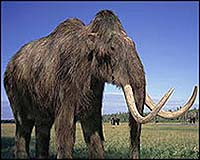
State College, Pa. (UPI) Jun 9, 2008 U.S. scientists say they have determined only two groups of the extinct woolly mammoth existed and neither had much genetic diversity. Pennsylvania State University geneticists said their finding is particularly interesting because it rules out human hunting as a contributing factor for the mammoth's disappearance, leaving climate change and disease as the most probable causes of extinction. "The population was split into two groups, then one of the groups died out 45,000 years ago, long before the first humans began to appear in the region," said Associate Professor Stephan Schuster, who led the research with Professor Webb Miller. He said the study marks the first time scientists have dissected the structure of an entire population of extinct mammals by using the complete mitochondrial genome -- all the DNA that makes up all the genes found in the mitochondria structures within cells. The study included experts in genome evolution, ancient DNA, mammoth paleontology and curators from natural history museums in Denmark, Australia, Belgium, France, Italy, Russia, Spain, Sweden, the United Kingdom and the United States. The findings are reported in the early online edition of the Proceedings of the National Academy of Sciences. Related Links Darwin Today At TerraDaily.com
 Novel Bacterial Species Found Trapped In Greenland Icecap
 University Park PA (SPX) Jun 08, 2008
A team of Penn State scientists has discovered a new ultra-small species of bacteria that has survived for more than 120,000 years within the ice of a Greenland glacier at a depth of nearly two miles. The microorganism's ability to persist in this low-temperature, high-pressure, reduced-oxygen and nutrient-poor habitat makes it particularly useful for studying how life, in general, can survive in a variety of extreme environments on Earth and possibly elsewhere in the solar system. |
|
|

| The content herein, unless otherwise known to be public domain, are Copyright Space.TV Corporation. AFP and UPI Wire Stories are copyright Agence France-Presse and United Press International. ESA Portal Reports are copyright European Space Agency. All NASA sourced material is public domain. Additional copyrights may apply in whole or part to other bona fide parties. Advertising does not imply endorsement, agreement or approval of any opinions, statements or information provided by Space.TV Corp on any Web page published or hosted by Space.TV Corp. Privacy Statement |