|
 |
 |
 |
 |
 |
 |
 |
 |

 |
Worldwide Hunt To Solve The Mystery Of Gamma-Ray Bursts
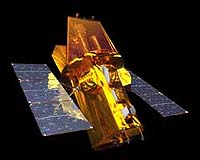
Leicester UK (SPX) Feb 18, 2008 UK space scientist Emeritus Professor Alan Wells is to speak at the American Association for the Advancement of Science (AAAS) in Boston in February on: International Cooperation in Developing Swift and its Scientific Achievements. Professor Wells' presentation will be part of a symposium entitled: Worldwide Hunt to Solve the Mystery of Gamma-Ray Bursts. In it, he will discuss the breadth of international collaborations, including the prominent contributions from UK scientists, in new discoveries about gamma ray bursts obtained from the Swift satellite and coordinated observations from a global network of ground based telescopes. Gamma-ray bursts are short-lived events, lasting between a few milliseconds to a few minutes. The brightest of them emit more energy in a few seconds than our Sun will emit in its whole 10 billion year lifetime. Gamma ray bursts are occurring several times daily somewhere in the universe, fortunately at huge distances from our solar system. These fleeting explosions are precursors to the births of black holes. The Swift Gamma Ray Burst Explorer satellite is a NASA mission with substantial UK and Italian participation. Swift was designed to solve the mystery of the origin of gamma ray bursts by pinpointing the burst and measuring the emissions from the huge fireball that occurs in the first few seconds of the burst's lifetime. Scientists at Leicester's world-renowned Space Research Centre are part of the international team working on the Swift, having had a major role in the development of the X-ray telescope, which has been responsible for many of the discoveries made by Swift. Since its launch in 2004, Swift has discovered over 292 gamma-ray bursts, and pin-pointed a further 320 bursts detected by other satellites. Swift's rapid response - it was named after the bird, which catches its prey "on the fly" - has been critical to understanding these titanic events. In 2007 the international Swift team, under NASA scientist Neil Gehrels and including UK scientists from the University of Leicester and the Mullard Space Science Laboratory, were awarded the prestigious Bruno Rossi Prize for major advances in the scientific understanding of gamma-ray bursts. The prize is given each year by the High Energy Astrophysics Division (HEAD) of the American Astronomical Society (AAS), the largest professional organization of astronomers in the United States. This was the first time that a UK mission team has been cited for the Rossi Prize. Related Links University of Leicester Stellar Chemistry, The Universe And All Within It
 X-rays Betray Giant Particle Accelerator In The Sky
 Paris, France (ESA) Jan 28, 2008
ESA's orbiting gamma-ray observatory, Integral, has made the first unambiguous discovery of highly energetic X-rays coming from a galaxy cluster. The find has shown the cluster to be a giant particle accelerator. The Ophiuchus galaxy cluster is one of brightest in the sky at X-ray wavelengths. |
|
|

| The content herein, unless otherwise known to be public domain, are Copyright Space.TV Corporation. AFP and UPI Wire Stories are copyright Agence France-Presse and United Press International. ESA Portal Reports are copyright European Space Agency. All NASA sourced material is public domain. Additional copyrights may apply in whole or part to other bona fide parties. Advertising does not imply endorsement, agreement or approval of any opinions, statements or information provided by Space.TV Corp on any Web page published or hosted by Space.TV Corp. Privacy Statement |