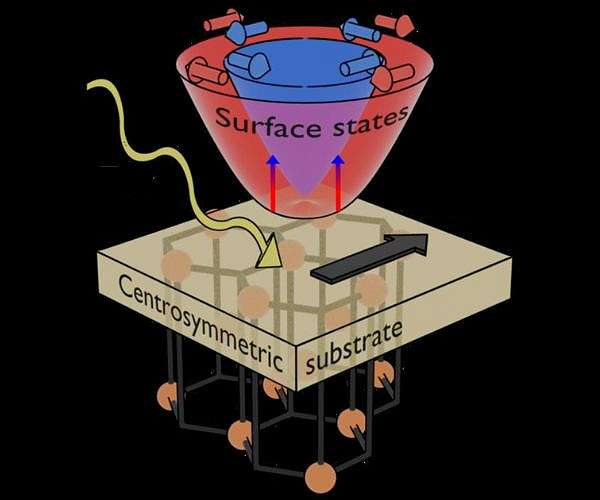
A new study shows that perfectly symmetric materials can generate strong photocurrents when their surfaces are engineered to host special electronic states, overturning a long held limitation in photovoltaic design. The work points to fresh strategies for both solar energy conversion and ultrafast spintronic technologies by exploiting the physics of surfaces rather than relying only on bulk crystal properties.
Conventional solar cells use interfaces such as p-n junctions to separate photo generated charges and produce useful current. Another mechanism, known as the bulk photovoltaic effect, can create direct current in a homogeneous material without such junctions, but it traditionally requires a non centrosymmetric crystal structure, which severely narrows the pool of candidate compounds for practical devices.
The research team from EHU, the Materials Physics Center, nanoGUNE and DIPC investigated how this symmetry requirement can be relaxed when surface electronic structure is taken into account. Using first principles calculations, they examined metals and semiconductors with strong relativistic spin orbit interaction and found that their surfaces can support electronic states that differ markedly from those in the bulk interior.
These surface states locally break inversion symmetry even though the underlying crystal remains perfectly symmetric. As a result, when light shines on the surface, the electronic response becomes nonlinear and generates robust photocurrents along the surface. The calculations predict not only charge currents but also pure spin polarized currents confined to the surface region.
After establishing the mechanism on the well studied Au(111) surface, the researchers identified Tl/Si(111) as a particularly promising platform to realize this effect. According to their results, Tl/Si(111) should exhibit photocurrents comparable in magnitude to those observed in leading ferroelectric materials that rely on bulk non centrosymmetry to produce large photovoltaic responses.
The work suggests a new direction for light to electricity conversion in which device designers focus on tailoring surface electronic properties rather than searching only for complex non centrosymmetric crystals. By engineering suitable surface states on otherwise symmetric substrates, it may become possible to build efficient photovoltaic systems from a far wider range of materials.
Beyond energy harvesting, the ability to generate and control spin currents with light at a surface has important implications for spintronics. The proposed mechanism does not require magnetic materials or applied voltages to create spin polarized currents, opening a path toward ultrafast, low power spin based devices that operate purely through optical excitation.
The study appears in the journal Physical Review Letters, where the authors outline both the theoretical framework and specific experimental signatures that could confirm their predictions. These signatures include characteristic current directions and spin textures at the surface, which experimentalists can probe using established spectroscopic and transport techniques.
Research Report: Surface-State Engineering for Generation of Nonlinear Charge and Spin Photocurrents